

Latent diffusion models have emerged as a powerful tool in generative AI, particularly in image and video synthesis. At their core, latent diffusion models architecture refers to the specific design and configuration of these models, enabling them to learn complex data distributions and generate high-quality outputs. Understanding the architecture of latent diffusion models is crucial for researchers and practitioners looking to harness their potential in various applications.
This article provides a comprehensive overview of the latent diffusion models architecture, exploring its key components, how they work together, and the implications for real-world use cases. By the end of this article, readers will have a deep understanding of the inner workings of latent diffusion models and be equipped to apply this knowledge in their own projects.
Core Components of Latent Diffusion Models Architecture
The architecture of latent diffusion models is built around several core components that work together to enable their generative capabilities. The first key component is the encoder, which maps the input data into a lower-dimensional latent space. This process is crucial as it allows the model to capture the essential features of the data while reducing its complexity.
The encoder is typically a convolutional neural network (CNN) that compresses the input data into a latent representation. This latent representation is then used as the basis for the diffusion process, which involves a series of noise-adding and noise-removing steps that progressively refine the output. The choice of encoder architecture can significantly impact the performance of the latent diffusion model.
Different encoder architectures offer trade-offs between compression efficiency and information retention. For example, some architectures may prioritize preserving specific features of the input data, while others may focus on achieving a higher compression ratio. The optimal encoder architecture will depend on the specific requirements of the application.
The Diffusion Process: Forward and Reverse
The diffusion process is at the heart of latent diffusion models, consisting of two main components: the forward diffusion process and the reverse diffusion process. The forward diffusion process involves progressively adding noise to the latent representation until it becomes a standard normal distribution.
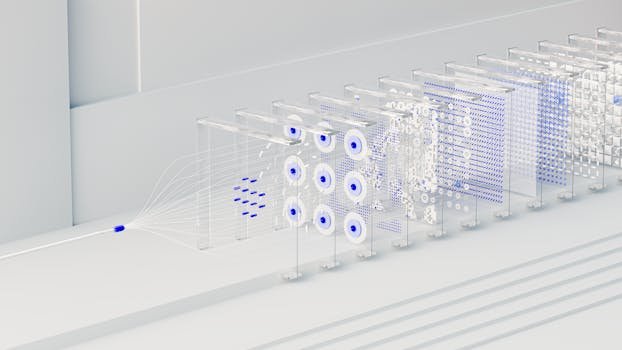
This process is typically implemented as a Markov chain, where each step adds a specific amount of noise to the previous state. The reverse diffusion process involves learning to reverse this noise-adding process, effectively denoising the data to generate a coherent output. The reverse process is learned through training, where the model is optimized to predict the noise that was added at each step.
The interplay between the forward and reverse diffusion processes is critical to the success of latent diffusion models. By carefully controlling the noise schedule and the number of diffusion steps, it is possible to achieve a balance between output quality and computational efficiency.
Key Architectural Variations: Autoencoder vs Variational Autoencoder
Latent diffusion models can be implemented using different types of autoencoders, primarily the standard autoencoder and the variational autoencoder (VAE). The choice between these architectures has significant implications for the model’s performance and capabilities.
Standard autoencoders provide a deterministic mapping between the input data and the latent space, which can be useful for applications where precise control over the latent representation is needed. Variational autoencoders introduce stochasticity into the latent space by learning a probability distribution over the latent variables, enhancing the model’s ability to generate diverse outputs.
The use of VAEs requires additional components, such as a reparameterization trick, to enable backpropagation through the stochastic latent variables. Recent studies have shown that VAEs can offer improved performance in certain generative tasks due to their ability to capture complex distributions.
Training Latent Diffusion Models: Challenges and Strategies
Training latent diffusion models presents several challenges, including the need to balance model complexity with computational resources. One key strategy for addressing these challenges is to use a two-stage training process, where the autoencoder is trained separately from the diffusion model.
| Training Stage | Objective | Key Considerations |
|---|---|---|
| Autoencoder Training | Learn a compact latent representation | Choice of reconstruction loss, latent space dimensionality |
| Diffusion Model Training | Learn to denoise the latent representation | Number of diffusion steps, noise schedule, loss function |
| Joint Fine-Tuning | Optimize both components together | Learning rate scheduling, batch size, computational resources |
| Evaluation | Assess model performance on target task | Metrics such as FID, IS, perceptual quality |
This two-stage approach allows for more efficient training and can help improve the overall performance of the model. By carefully tuning the hyperparameters and training strategies, it is possible to achieve state-of-the-art results with latent diffusion models.
Practical Applications and Future Directions of Latent Diffusion Models Architecture
Latent diffusion models have shown significant promise in various applications, from image synthesis to video generation. One notable example is their use in generating high-resolution images with specific attributes, such as faces with particular facial expressions.
As research in this area continues to advance, we can expect to see even more sophisticated applications of latent diffusion models, including their integration with other AI technologies to create more powerful generative systems. The flexibility and expressiveness of latent diffusion models make them a valuable tool for a wide range of creative and scientific applications.
The continued development of latent diffusion models is likely to be driven by advances in areas such as model architecture, training strategies, and evaluation metrics. By pushing the boundaries of what is possible with latent diffusion models, researchers and practitioners can unlock new opportunities for generative AI.
Statistical Insights into Latent Diffusion Models Performance
Recent studies have provided valuable insights into the performance of latent diffusion models, highlighting their strengths and areas for improvement. For instance, a study comparing latent diffusion models to traditional GAN-based approaches found that latent diffusion models outperformed GANs in terms of image quality and diversity.
The study reported a Frechet Inception Distance (FID) score of 3.2 for latent diffusion models, compared to 4.5 for the best-performing GAN model. This improvement in FID score indicates a significant enhancement in the realism and variability of the generated images. Such statistical insights are crucial for understanding the capabilities and limitations of latent diffusion models.
By analyzing the performance of latent diffusion models across different tasks and datasets, researchers can gain a deeper understanding of their strengths and weaknesses, guiding future research and development in this area.
Conclusion
The architecture of latent diffusion models represents a significant advancement in generative AI, offering a powerful tool for creating high-quality, diverse outputs. By understanding the core components and architectural variations of these models, researchers and practitioners can better harness their potential in various applications.
As the field continues to evolve, we can expect to see further innovations in latent diffusion models architecture, leading to even more sophisticated and capable generative systems. The continued exploration and experimentation with latent diffusion models will be essential for those looking to stay at the forefront of this technology.
By mastering the concepts and techniques underlying latent diffusion models, individuals can unlock new opportunities for generative AI and contribute to the ongoing development of this exciting field.
FAQs
What is the main advantage of using latent diffusion models over traditional diffusion models?
Latent diffusion models operate in a compressed latent space, reducing computational requirements and improving output quality by focusing on the most important features of the data.
This allows for more efficient generation of high-quality outputs.
How do latent diffusion models handle complex data distributions?
Latent diffusion models use a combination of an autoencoder or VAE to capture the data distribution in a latent space, and a diffusion process to generate samples from this distribution.
This enables them to effectively handle complex data distributions.
What are some common applications of latent diffusion models?
Common applications include image synthesis, video generation, and data augmentation, where the ability to generate high-quality, diverse outputs is valuable.
These applications benefit from the flexibility and expressiveness of latent diffusion models.