
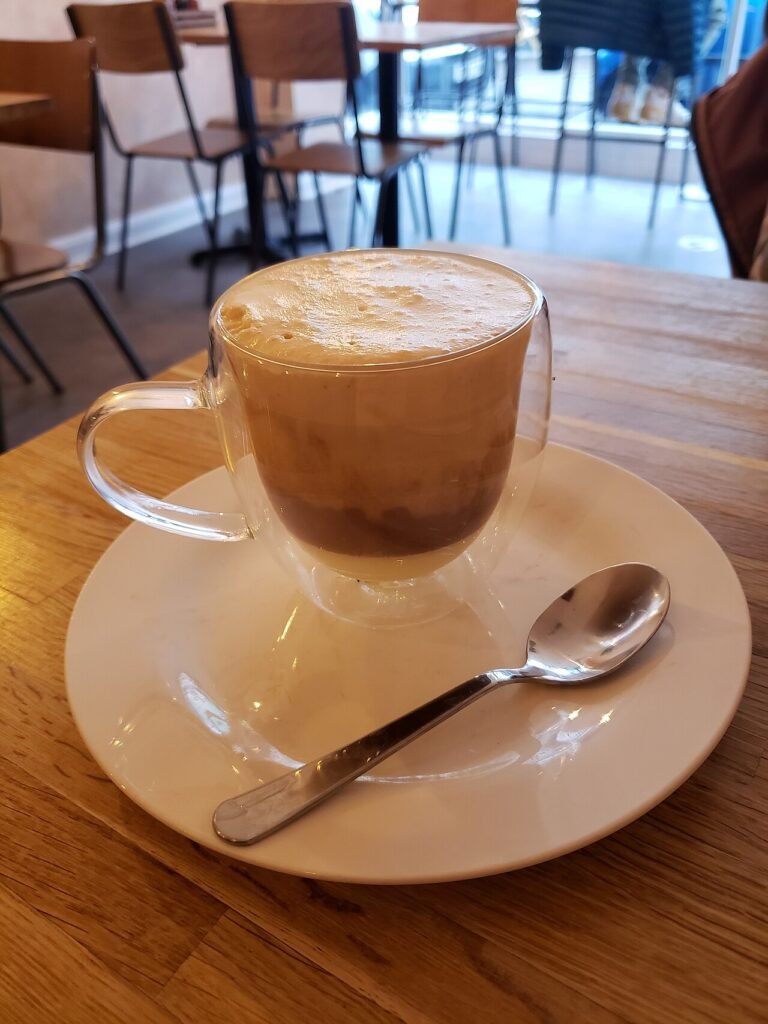
Vietnamese salt coffee, or cà phê muối (often written ca phe muoi), is strong phin coffee sweetened with condensed milk and finished with lightly salted cream or milk. The salt is said to soften the bitter coffee and balance the sweet milk, and the effect is often compared to salted caramel. The drink comes from Huế, where a café called Cà Phê Muối is widely credited with creating it around 2010.
What is Vietnamese salt coffee?
CNN describes salt coffee as Vietnamese coffee with condensed milk, topped with salted cream and served hot or iced. VnExpress describes the original Huế cup differently: condensed milk at the bottom, fermented milk and salt added to it, and a phin filter on top, so the coffee drips onto the milk and changes color as it mixes. The drinker then stirs.
Versions vary. Saveur notes that while many cafés top strong coffee with whipped salted cream, Hue Cafe Roastery in Saigon blends the salt into the coffee and condensed milk instead.
What does salt coffee taste like?
Salty, sweet and bitter at once. VnExpress notes that first-time drinkers can find the mix strange, while a longtime customer of the original café called it a harmonious combination of bitter, sweet and salty. The travel guide Vietnam Coracle and CNN both compare it to salted caramel. CNN says the salt heightens the sweetness, the way a little salt brings out the caramel flavor.
Hue salt coffee: where it comes from
The café most often credited with the drink is Cà Phê Muối in Huế (often written Hue), the former imperial capital in central Vietnam. Its co-owners, Hồ Thị Thanh Hương and Trần Nguyễn Hữu Phong, told CNN Travel in 2024 that they created salt coffee in 2010, when they opened their first shop at 10 Nguyễn Lương Bằng Street. They wanted something different to draw customers, they said, in a city used to black coffee with sugar or condensed milk.
Accounts differ, even within one newspaper. VnExpress wrote in 2020 that the drink appeared about 10 years earlier, inspired by a love story Hương came across, in which a nervous young man on a first date asks for salt in his coffee. Its 2023 profile says a love story gave the shop its name, and that the shop sold only traditional coffee at first, with salt coffee developed later. Chowhound dates the invention to around 2012 and counts the love story among the folk tales told about the drink.
Viet Nam News has linked the drink to Huế’s long tradition of salt dishes. According to Vietnam Coracle, the recipe stayed a secret until neighboring cafés began serving their own versions toward the end of the 2010s. The couple never patented it, Chowhound reported in 2024, and still keep their exact recipe private.
Salt coffee vs egg coffee vs cà phê sữa đá
All three are built on strong Vietnamese coffee and condensed milk.
- Cà phê sữa đá is the everyday version. Saveur sums it up as phin coffee plus condensed milk and ice: bitter, sweet and cold. There is no salt and no topping.
- Egg coffee (cà phê trứng) comes from Hanoi and is traced to the 1940s. Its topping is egg yolk whipped with condensed milk, and Saveur describes the taste as rich and custardy. See the full guide to Vietnamese egg coffee.
- Salt coffee comes from Huế and dates to around 2010. It uses no egg. The salt goes into whipped cream or, in VnExpress’s account of the original Huế cup, into fermented milk beneath the coffee.
Why salt changes the taste of coffee
Lab research offers a partial explanation. In a 1997 paper in Nature, two researchers at the Monell Chemical Senses Center in Philadelphia tested their earlier proposal that salts suppress unpleasant tastes such as bitterness more than pleasant ones such as sweetness. When they added a sodium salt to a mixture of bitter urea and sweet sucrose, bitterness fell sharply and the mixture tasted sweeter.
The effect depends on the bitter compound. A 2001 summary by the same researchers and a colleague reports that sodium salts cut the bitterness of urea by more than 70 percent but were less effective against caffeine. The tests used simple lab solutions made with deionized water, not brewed coffee, so they support the general idea without showing what salt does to a particular cup.
Writers also differ on the salt’s job. The Huế owners told CNN their mix softens the coffee’s bitterness, while Chowhound argues that salt is a flavoring in its own right here.
Salt coffee recipe: how to make it at home
Home recipes follow the salted cream style. The amounts below come from Vicky Pham’s salted cream (kem muối) recipe and Dame Cacao’s single-serving salt coffee, with the coffee dose from the phin guides of Nguyen Coffee Supply and Copper Cow Coffee.
Ingredients (one drink)
- Ground coffee: about 14 g (2 tablespoons), ground medium-fine. Robusta is the usual choice; Saveur notes that Vietnamese coffee has historically centered on it.
- Hot water: about 120 ml (4 oz).
- Sweetened condensed milk: either a tablespoon or two in the glass, the amount CNN says many people stir into phin coffee, or in the cream only. Dame Cacao whips 2 tablespoons into the cream for one drink. Vicky Pham whips 1/4 cup into a batch of cream for 5 to 6 drinks, served over unsweetened coffee.
- Milk (optional): about 1/2 cup in the glass if you sweeten only the cream, as Dame Cacao does.
- Heavy whipping cream: 1/4 cup per drink (Dame Cacao), or 1 cup of cream plus 2 tablespoons of milk per batch (Vicky Pham).
- Salt: 1/4 teaspoon of sea salt per drink, more to taste (Dame Cacao), or 1/2 teaspoon of finely ground sea salt per batch (Vicky Pham, who suggests a little less if using table salt, which is slightly saltier).
- Ice, for the iced version.
Steps
- Spoon the condensed milk into a heatproof glass, unless you are sweetening only the cream, and set the phin on top.
- Add the coffee, bloom it with a little hot water, then fill the chamber and let it drip through. For grind and timing in detail, see this guide on how to use a phin filter.
- While it drips, whip the cold cream with the salt and any condensed milk. Vicky Pham whips on medium-high for about two and a half minutes, stopping as soon as the cream thickens slightly but still pours. Dame Cacao goes to soft peaks while keeping it loose enough to pour.
- Stir the coffee into the condensed milk or, if you are sweetening only the cream, pour it over the milk. For iced salt coffee, add ice.
- Spoon or pour the salted cream on top so it floats. Dame Cacao suggests stirring it in just before drinking, or eating the cream with a spoon.
Vicky Pham recommends very cold cream and a bowl chilled in the freezer for about 15 minutes, and loosens over-whipped cream with a little more milk. Leftover cream keeps in an airtight container in the refrigerator for up to three days.
Hot or iced?
Both. CNN reports that the original café serves salt coffee hot and iced, and that its owners think the iced version tastes best. In VnExpress’s 2020 account of the Huế cup, drinkers stir once the coffee has dripped onto the salted layer, then add ice themselves. Vietnam Coracle notes that the original café lets customers decide on ice, while most Ho Chi Minh City vendors it visited serve the drink ready-made, seldom offering that choice.
Where salt coffee is popular now
The owners told CNN that salt coffee seemed to become a trend across Vietnam after the Covid years, and CNN described it in 2024 as ubiquitous in Huế cafés and a common option on menus nationwide. Viet Nam News reported in 2023 that it could be found at nearly every sidewalk café in Hanoi. In a guide first published in 2023, Vietnam Coracle put Cà Phê Muối Chú Long, a Ho Chi Minh City chain, at more than 20 stores. Starbucks branches in Vietnam launched their own version in May 2024, according to CNN, which also named Phin Ca Phe in Seattle and Càphê Roasters in Philadelphia among US cafés serving it.
In Huế, the couple had two shops as of 2024: the original on Nguyễn Lương Bằng Street and a larger one on Đặng Thái Thân Street, close to the Citadel.
Frequently asked questions
Who invented salt coffee?
It is widely credited to Hồ Thị Thanh Hương and Trần Nguyễn Hữu Phong of Cà Phê Muối in Huế, who told CNN they created it in 2010. A 2023 VnExpress profile says the shop sold only traditional coffee at first, and Chowhound places the invention around 2012.
Is salt coffee actually salty?
Somewhat. A longtime customer of the original café told VnExpress it tastes slightly bitter, aromatic and salty, and CNN notes that the sweetened milk and cream balance the coffee’s bitterness.
How much salt goes in salt coffee?
Not much. Dame Cacao uses 1/4 teaspoon of sea salt for one drink, and Vicky Pham uses 1/2 teaspoon in a batch of salted cream that tops 5 to 6 drinks. The original Huế café has not published its amounts.
Can you make salt coffee without a phin?
Yes. Vicky Pham tops any unsweetened brewed coffee with her salted cream, and Dame Cacao’s recipe works with two shots of espresso or 1/2 cup of strong brewed coffee, though it recommends a phin for a more authentic cup.
Part of the Vietnamese coffee guide.
Featured image: A cup of salt coffee (cà phê muối). Photo: Andy Li, CC0, via Wikimedia Commons.