Vietnamese egg coffee, or cà phê trứng (often written ca phe trung), is strong Vietnamese coffee topped with a thick, sweet foam of egg yolk whisked with sweetened condensed milk and, in many recipes, a little sugar. It comes from Hanoi, where the most widely told story credits Nguyễn Văn Giảng, who worked at the Metropole hotel and turned to whisked egg yolk in the 1940s because fresh milk was scarce.
What is egg coffee?
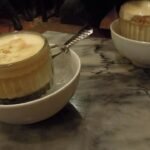
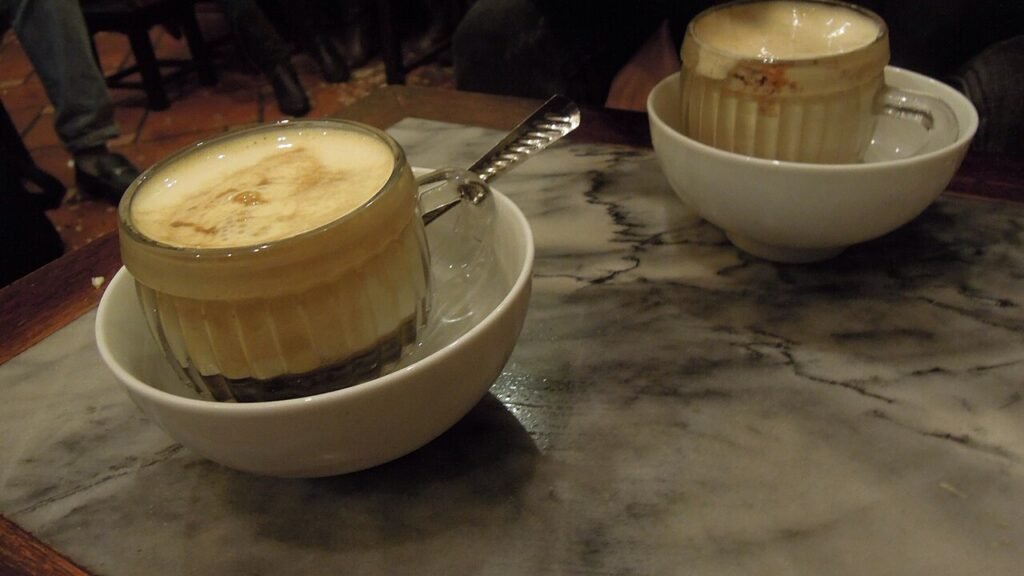
Egg coffee is built in two layers. The base is dark, strong coffee, usually robusta brewed slowly through a phin, the small Vietnamese drip filter. On top sits a pale, airy cream of whipped egg yolk and condensed milk that floats on the coffee as a separate layer. In Hanoi, the hot version often arrives in a small cup set inside a bowl of hot water to keep it warm. At Café Giảng, Xinhua reported, a teaspoon comes with it so the foam can be eaten before the coffee underneath is drunk.
What does egg coffee taste like?
Vicky Pham describes a custard, tiramisu-like flavor, and other guides compare the drink to liquid tiramisu, custard or zabaglione. The Vietnam Airlines travel guide singles out the contrast between the bitter coffee and the sweet, creamy egg mixture, and Food Republic credits the yolks with giving the drink its thick, creamy texture.
The origin story of cà phê trứng
Nguyễn Văn Giảng worked at the Metropole hotel in Hanoi, which opened in 1901 and still operates today as the Sofitel Legend Metropole Hanoi. In a 2018 Xinhua report, Giảng’s youngest son, then the owner of Café Giảng, said his father created the drink in 1946 while working as a bartender at the hotel, after a milk shortage forced him to look for alternatives. Two 2026 guides name a different son, one of them alongside a daughter, as running it now.
Many accounts, including Xinhua, Mental Floss and a 2025 Việt Nam News report, give the year as 1946, and several describe Giảng as a bartender. Mental Floss links the shortage to the First Indochina War. Café Giảng’s own website tells it differently: it says he worked at the hotel as a chef, places his experiments with whisked egg yolks and sugar in the 1940s, and dates the founding of the café to 1946. Wikipedia’s summary, based on the founder’s son’s account, puts the invention in the late 1940s.
A 2026 Day Trips Vietnam guide says the 1946 founding of Café Giảng is an operator and family claim that it corroborated against secondary press but could not verify against documents from the time, while adding that the dates are widely accepted within Vietnam.
According to VietNamNet, Giảng left the hotel to sell egg coffee under his own brand, and the Day Trips guide says the café is still operated by his family. A 2020 VietNamNet piece quotes one of his sons as saying the original recipe included yolk, condensed milk, coffee powder, butter, cheese and some secret ingredients, and a 2018 VOV report gave the same main ingredients. His daughter, Bích, opened another family café, Café Đinh, which two 2026 guides date to 1987.
Egg coffee recipe: how to make it at home
Published recipes broadly agree on the method but not on the amounts. The quantities below are the ranges given by Tasty, Vicky Pham, Legal Nomads, Tonkin Coffee and Analida’s Ethnic Spoon. Adjust to taste.
Ingredients (one drink)
- Egg yolks: 1 to 2, though Ethnic Spoon stretches a single yolk across two cups. Vicky Pham’s recipe calls for pasteurized yolks (see the safety section below).
- Sweetened condensed milk, for the egg cream: from 2 teaspoons (Legal Nomads) to about 2 tablespoons (Ethnic Spoon uses 4 tablespoons for two cups). Tonkin Coffee says 2 to 3 spoonfuls without naming the spoon size. Tasty adds 2 more tablespoons under the coffee, for 3 in total.
- Sugar (optional): about 1 teaspoon in the Tasty and Vicky Pham recipes. Legal Nomads and Ethnic Spoon use none.
- Ground coffee: Vietnamese dark roast, often robusta, ground for a phin. Amounts run from 3 teaspoons (Legal Nomads) to 4 tablespoons (Vicky Pham), and Tonkin Coffee suggests 20 to 25 grams.
- Hot water: Tonkin Coffee uses roughly 55 to 65 ml in total, and Tasty uses 3/4 cup of boiling water.
- Ground cinnamon (optional): for dusting, as in the Tasty recipe.
Steps
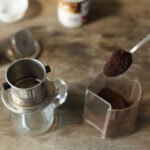
- Set the phin on a heatproof cup and add the coffee. Tasty presses the grounds lightly so they are compact but not tightly packed, while Vicky Pham packs them down firmly. New to the filter? See this guide on how to use a phin filter.
- Pour in a little hot water to wet the grounds, about 2 tablespoons in Tasty’s recipe or about 15 ml in Tonkin Coffee’s, and wait about 30 seconds while they bloom. Vicky Pham waits 15 seconds.
- Add the rest of the water, cover the filter and let the coffee drip through. Tasty and Tonkin Coffee both allow about 4 to 5 minutes.
- While the coffee drips, separate the eggs. Tonkin Coffee stresses keeping every trace of white out of the yolks.
- Whisk the yolks with the condensed milk and the sugar, if using, until the mixture turns pale yellow, thick and much larger in volume. Times depend on the tool: Tasty gives 3 to 5 minutes and notes that a hand mixer also works, Tonkin Coffee runs an electric hand mixer on high for 5 to 7 minutes, and Ethnic Spoon uses a hand blender for about 10 minutes.
- Remove the phin and spoon the foam over the coffee so it floats as its own layer. Dust with cinnamon if you like.
- Serve straight away. To keep it hot the Hanoi way, set the cup in a bowl of hot water. Eat the foam with a spoon, or stir it in.
Hot vs iced egg coffee
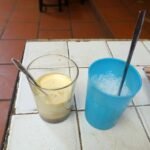
The hot version is the original and remains the one most closely tied to Hanoi. The iced version came later. According to the 2018 Xinhua report on Café Giảng, the cold option was introduced in the 2000s and arrives as a yellow drink in a small glass that tastes almost like coffee-flavored ice cream, more dessert than coffee. The Vietnam Airlines travel guide describes iced egg coffee as lighter and more refreshing. At home, Vicky Pham’s method is to let the brewed coffee cool, pour it over ice and then add the egg cream. For a simpler cold drink with condensed milk and no egg, see the guide to Vietnamese iced coffee.
Variations: cocoa, matcha and more
The café’s then owner told Xinhua in 2018 that he began making cocoa and white bean egg drinks in 1999 and in 2010 realized that rum and beer could complement egg. A 2020 VietNamNet report listed egg coffee with rum, green bean, chocolate, cinnamon and green tea on the café’s menu, along with egg beer. The Vietnam Airlines guide mentions matcha egg coffee, cocoa egg coffee and egg beer at some cafés, and LocalVietnam describes egg cacao, which replaces the coffee with hot chocolate.
Is raw egg yolk safe?
In the recipes above, the yolk is whisked raw, which carries a food safety risk. The US Food and Drug Administration warns that fresh eggs, even those with clean, uncracked shells, may contain Salmonella bacteria, and that children, older adults, pregnant women and people with weakened immune systems are at greater risk of severe illness.
For recipes in which eggs are raw or undercooked when the dish is served, the FDA advises using shell eggs that have been treated to destroy Salmonella, by pasteurization or another approved method, or pasteurized egg products. Tasty’s recipe likewise notes that pasteurized yolks can reduce the risk. For cafés, Beyond Vietnam’s guide suggests established places with good turnover and careful handling, particularly for higher-risk drinkers, and adds that a popular café is not a guarantee.
Where to try egg coffee in Hanoi
Recent guides name these places for egg coffee in Hanoi.
- Café Giảng: the family’s original café in the Old Quarter. A 2026 guide describes a narrow alley entrance and a small upstairs room.
- Café Đinh: the café opened by Giảng’s daughter, Bích, set upstairs facing Hoàn Kiếm Lake.
- Cafe Pho Co: a 2026 Day Trips Vietnam guide groups it with Café Giảng and Café Đinh in an egg coffee triangle. It is entered through a shop at street level and has a rooftop looking out over Hoàn Kiếm Lake.
- Sofitel Legend Metropole Hanoi: the hotel where the story begins. Forbes Travel Guide lists egg coffee at its La Terrasse among the hotel’s must-do Hanoi traditions, while a 2025 Việt Nam News report on a Euronews guide points visitors to its Le Club Bar.
Prices and opening hours change, so check with each venue before going.
Frequently asked questions
Is egg coffee safe?
The risk comes from the raw yolk. The FDA warns that fresh eggs may contain Salmonella and, for dishes served with raw or undercooked egg, advises shell eggs treated to destroy Salmonella or pasteurized egg products. Children, older adults, pregnant women and people with weakened immune systems are at greater risk of severe illness.
Does egg coffee taste like eggs?
Opinions differ. LocalVietnam says it does not taste eggy in the way most people fear, while a 2026 Day Trips Vietnam guide calls it sweet and eggy. Tonkin Coffee recommends thorough whisking to reduce any raw flavor.
Can you make egg coffee without a phin?
Yes. Vicky Pham suggests brewing 2 to 3 ounces of strong coffee by any method, such as espresso, drip or French press, and Ethnic Spoon’s recipe is built on espresso.
Who invented egg coffee?
Nguyễn Văn Giảng is credited by his family and by Café Giảng, and 1946 is the year most often given. A 2026 guide notes that the 1946 founding of Café Giảng could not be checked against records from the time.