Vietnamese coffee is strong because it is usually made from robusta beans, which taste more bitter than arabica and carry roughly 1.4 to 1.8 times the caffeine when brewed. It is also made in a phin filter with about twice as much coffee per ounce of water as standard drip, producing a small, concentrated cup that can hold more caffeine than an 8-ounce cup of drip coffee. A dark roast, when used, deepens the bitterness without adding caffeine.
Robusta: the bean behind the strength
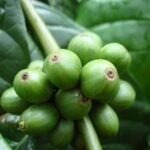
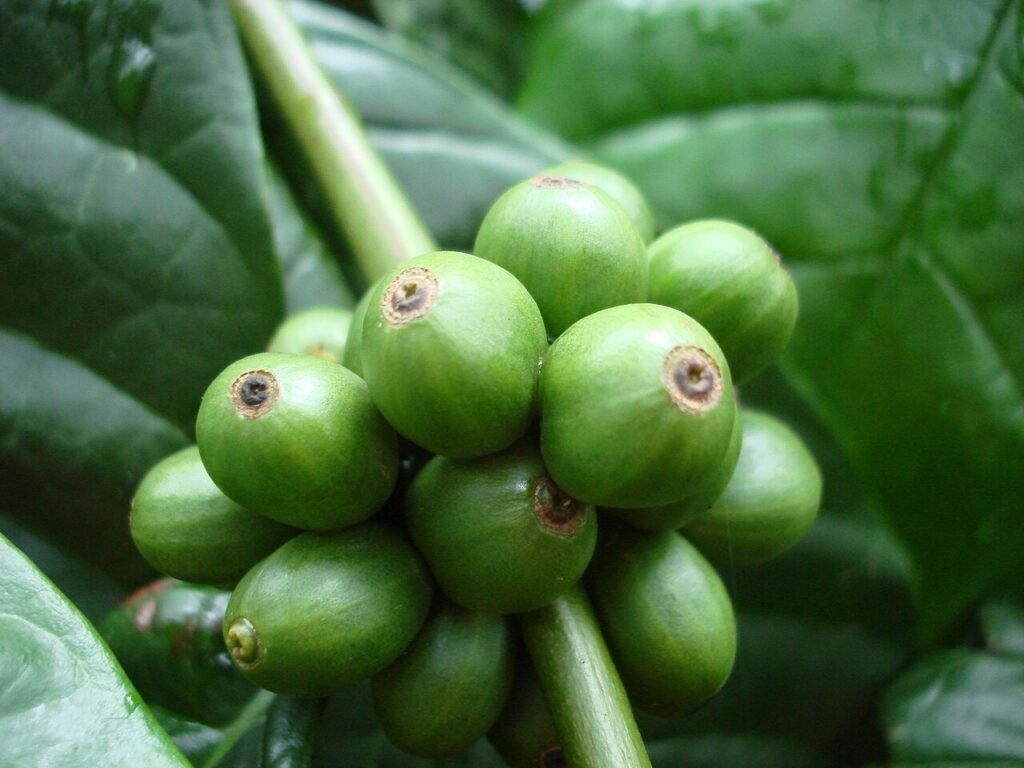
Most upscale American cafés use arabica (Coffea arabica), a bean prized for a relatively light, fruity flavor. Vietnam’s crop is overwhelmingly robusta (Coffea canephora), a different species with more caffeine and a heavier taste.
Green arabica beans contain on average 0.9 to 1.5 percent caffeine by dry weight, while green robusta beans contain 1.2 to 2.4 percent, according to a 2021 review of caffeine research in the journal Foods. That is roughly 9 to 15 mg of caffeine per gram of green arabica against 12 to 24 mg per gram of green robusta. Looking at brewed coffee, the same review concluded that most studies show robusta brews with about 1.4 to 1.8 times the caffeine of arabica brews, although coffee writers often round the difference up to “almost double.”
Robusta also tastes different. World Coffee Research describes brewed robusta as often lower in acidity, higher in bitterness and more full-bodied, and Saveur has described Vietnamese robusta as nutty and cocoa-like. That bitterness reads as strength on the tongue, and caffeine is only a small part of it.
Why Vietnam grows mostly robusta
Coffee reached Vietnam in 1857, brought by French missionaries. Robusta thrives at lower altitudes than arabica, and World Coffee Research notes it can produce high yields at 200 to 800 meters above sea level. Vietnam’s coffee association has credited the country’s tropical climate and fertile red soil for its robusta, with arabica grown higher up in the northern mountains. Most of today’s crop comes from the Central Highlands.
Production suffered through the Vietnam War and its aftermath, then recovered after the Đổi Mới reforms of 1986, when the government backed coffee as a cash crop and let privately owned businesses grow and produce it.
Vietnam’s place in world coffee
Vietnam is the world’s second-largest coffee producer after Brazil. The US Department of Agriculture forecasts a record Vietnamese crop of 32.5 million 60-kilogram bags for 2026/27, against 71.9 million for Brazil and a world total of about 189.7 million. Of Vietnam’s bags, 31.4 million are expected to be robusta: roughly 97 percent of its crop and more than a third of all the robusta grown worldwide, which makes Vietnam the largest robusta producer.
Dark roasts: a stronger taste, not reliably more caffeine
Some phin guides call for a dark roast. Nguyen Coffee Supply, a US importer of Vietnamese beans, recommends its dark roast coffees for a stronger cup, while Saveur’s recipe calls for a medium roast.
Chemists led by Thomas Hofmann at the Technical University of Munich found that most of coffee’s bitterness comes from compounds formed during roasting, with the harshest ones building up in dark roasts. They estimated that caffeine accounts for only about 15 percent of perceived bitterness. Studies on roast level and caffeine point in different directions. A 2024 study in Scientific Reports found that dark roasts generally gave lower caffeine concentrations than light and medium roasts brewed under identical conditions, but higher ones when compared at the same extraction yield. What a dark roast reliably adds is bitterness.
Some producers also roast with butter. SBS Food describes this as a traditional method: chef Jerry Mai says the Vietnamese beans used at her Melbourne restaurant, Annam, are roasted with butter and brandy, and credits the butter with adding richness at the back of the palate.
The phin makes a concentrate
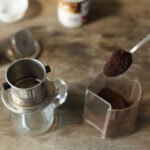
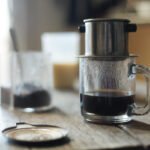
The phin is a small metal drip filter that sits on top of the cup (see how to use a phin filter). Hot water passes slowly through a packed bed of grounds, and the drip takes about five minutes in both Saveur’s and Nguyen Coffee Supply’s methods.
What makes it strong is the ratio. Saveur’s recipe uses 10 grams of coffee and 84 grams of water, and Nguyen Coffee Supply’s example uses 14 grams of coffee to 4 ounces of water. Both come to about 1 part coffee to 8.5 parts water. The filter coffee in a 2013 laboratory comparison of nine brewing methods used about 55 grams of coffee per liter, or roughly 1 part coffee to 18 parts water. A phin cup is therefore about twice as concentrated as standard drip, and small: only about 3 to 4 ounces of water go in, and some stays behind in the grounds. For the full method, see the step-by-step guide to how to make Vietnamese iced coffee.
How much caffeine is in Vietnamese coffee?
Published lab measurements of a standard phin cup are scarce, so any figure is an estimate. This one is built from measured inputs. In that 2013 study, which used a single arabica coffee, each gram of grounds gave up about 7 to 8 mg of caffeine in espresso machines and about 8.5 mg in drip brewers, including a porcelain gravity-drip pot. Treating the phin as somewhere between the two and applying that to a 10 to 14 gram dose suggests roughly 70 to 120 mg for an all-arabica cup. Multiplying by robusta’s 1.4 to 1.8 times advantage gives roughly 100 to 220 mg for an all-robusta cup. Many Vietnamese ground coffees blend the two species and would land in between, and a bigger dose raises the total.
| Drink | Serving | Caffeine | Basis |
|---|---|---|---|
| Drip coffee | 8 fl oz (237 ml) | About 95 mg | USDA FoodData Central |
| Espresso, single shot | 1 fl oz (about 30 ml) | About 63 mg | USDA FoodData Central |
| Phin coffee, all arabica | 10 to 14 g coffee, about 3 to 4 oz water | About 70 to 120 mg (estimate) | Lab extraction data per gram of coffee |
| Phin coffee, all robusta | 10 to 14 g coffee, about 3 to 4 oz water | About 100 to 220 mg (estimate) | Same data, times 1.4 to 1.8 |
Real cups vary widely. When researchers in Glasgow analyzed 20 espressos bought from coffee shops, caffeine differed sixfold, reaching 322 mg in a single serving, and they named the amount of coffee used as the likely main factor.
Why condensed milk makes it taste milder
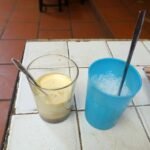
Sweetened condensed milk adds sugar, fat and volume, but no caffeine. What it changes is perception. In a study published in Chemical Senses, sucrose suppressed both the bitterness of caffeine and the flavor of coffee, while at similar intensities caffeine and coffee did not reduce perceived sweetness. Saveur’s recipe notes that condensed milk tempers the bitterness. A glass of cà phê sữa đá can therefore taste gentle while carrying every milligram of caffeine from the phin above it.
Condensed milk owes its place partly to its long shelf life, and SBS Food notes it remained the favorite coffee partner in Vietnam even after refrigerators became common.
How to make Vietnamese coffee milder
- Use less coffee. A smaller dose cuts caffeine roughly in proportion. Adding more water, as Nguyen Coffee Supply suggests with a second pour, softens the taste but does not lower the total caffeine.
- Choose arabica or an arabica-heavy blend. Vietnam grows a smaller arabica crop, about 1.1 million bags in the USDA’s 2026/27 forecast, and arabica carries less caffeine per gram.
- Try bạc xỉu. This Saigon-style drink uses more milk, so it is paler, creamier and less bitter. It only lowers caffeine if the coffee portion is smaller, so make it with a half dose.
- Split the cup. Sharing a phin halves the caffeine without changing the recipe.
Frequently asked questions
How much caffeine is in a cup of Vietnamese coffee?
An estimated 100 to 220 mg for a phin made with 10 to 14 grams of all-robusta coffee, and 70 to 120 mg for all-arabica, based on lab extraction data rather than direct measurement of phin cups. An 8-ounce cup of drip coffee holds about 95 mg, according to USDA data.
Is Vietnamese coffee stronger than espresso?
In total caffeine, a robusta phin cup very likely beats a single shot of espresso, which USDA data puts at about 63 mg. It uses more coffee than a typical single shot, and a higher-caffeine bean.
Does condensed milk make Vietnamese coffee weaker?
It makes it taste weaker without removing any caffeine. Sugar suppresses the perception of bitterness, but all the caffeine from the phin is still in the glass.
Is all Vietnamese coffee made with robusta?
No. Robusta makes up about 97 percent of Vietnam’s crop, but the country also grows arabica, and many commercial Vietnamese brands blend the two. A blend usually carries less caffeine than pure robusta.
How many cups of Vietnamese coffee is too many?
The US Food and Drug Administration cites 400 mg a day as an amount not generally associated with negative effects in healthy adults, while noting that sensitivity to caffeine varies widely. At an estimated 100 to 220 mg for an all-robusta phin, two strong cups could pass that level. If you are pregnant, trying to become pregnant or breastfeeding, the FDA recommends talking to your health care provider.