The essential things to do in Hanoi are exploring the Old Quarter and Hoàn Kiếm Lake, visiting the Temple of Literature, and eating your way through the city’s street food and coffee. This guide is for first-time visitors deciding what to do in Hanoi over two to four days, with opening details checked against official sources and recent news.
Old Quarter and Hoàn Kiếm Lake
1. Walk the Hanoi Old Quarter
The Hanoi Old Quarter packs 36 historic streets into roughly one square kilometer just north of Hoàn Kiếm Lake. Since the 15th century, its streets have been named for the trades practiced on them, though only a few still sell the same goods, such as Hàng Bạc (Silver Street), which still houses jewelry stores. Wander without a fixed route, and watch the traffic from a sidewalk café.
2. Circle Hoàn Kiếm Lake
Hoàn Kiếm means “Lake of the Returned Sword,” after the legend in which Emperor Lê Lợi, having defeated the Ming, gave a magic sword back to a golden turtle that surfaced from the water. The small Turtle Tower on an islet in the lake is linked to that story.
Practical note: Come at dawn, when locals gather by the water for jogging, tai chi and group games.
3. Ngọc Sơn Temple
Ngọc Sơn Temple sits on an islet in the northern part of the lake, reached by the red Thê Húc Bridge, first built in 1865. The temple honors Văn Xương, a deity associated with literature and examinations, and the national hero Trần Hưng Đạo. One of the lake’s giant soft-shell turtles is preserved inside.
4. Join the weekend walking street
On weekends, the streets around Hoàn Kiếm Lake close to vehicles and fill with families, folk games and performances. After dark, Hàng Đào street in the Old Quarter turns into a night market with street food and souvenirs.
Practical note: The city extends the pedestrian hours for holidays and events, so check the current schedule locally.
History and culture
5. Temple of Literature (Văn Miếu)
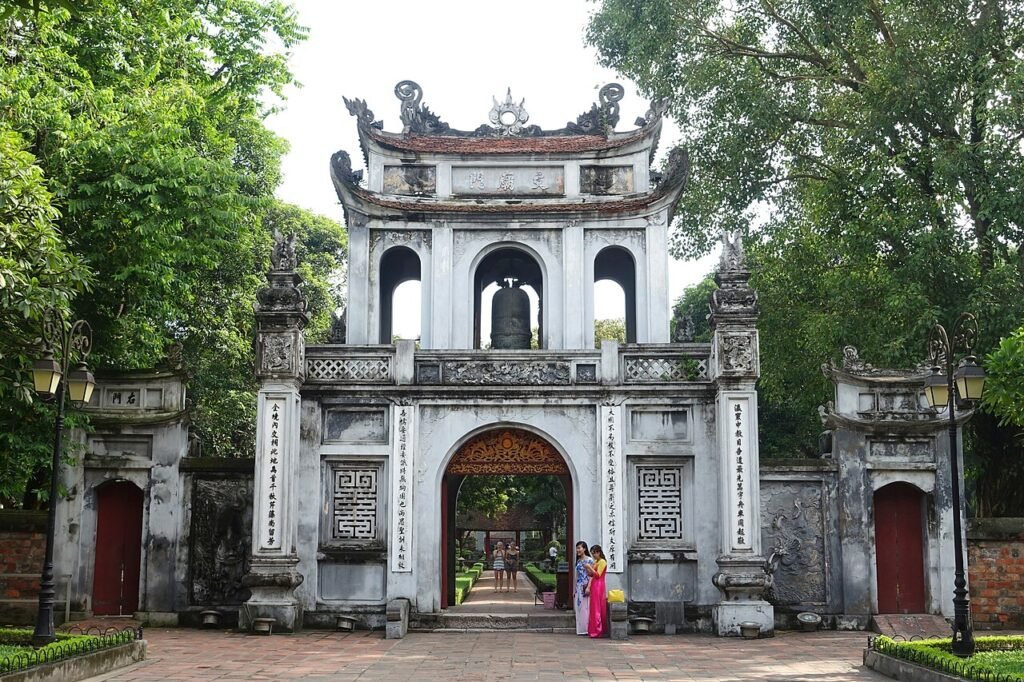
Founded in 1070 to honor Confucius, the Temple of Literature hosted Vietnam’s first national university, the Imperial Academy, from 1076. Within its five courtyards stand 82 stone stelae set on carved stone turtles, recording the names and birthplaces of 1,307 graduates of the royal exams. The stelae are on UNESCO’s Memory of the World Register.
Practical note: The official site lists hours of 8:00 a.m. to 5:00 p.m. every day, plus a separately ticketed night tour from 6:30 to 10:00 p.m. on Wednesdays, Saturdays and Sundays. As of October 2026, a standard adult ticket is 70,000 VND, and children under 16 enter free.
6. Ho Chi Minh Mausoleum complex
Ho Chi Minh’s embalmed body lies in a granite mausoleum on Ba Đình Square, where he read Vietnam’s Declaration of Independence on September 2, 1945. The surrounding memorial complex includes the Ho Chi Minh Museum and Ho Chi Minh’s stilt house. Expect long queues.
Practical note: Viewing is in the morning only, on Tuesday, Wednesday, Thursday, Saturday and Sunday. From November 1 to March 31 it runs from 8:00 to 11:00 a.m. (Saturdays until 11:30 a.m.), and from April 1 to October 31 from 7:30 to 10:30 a.m. (weekends and holidays until 11:00 a.m.). The mausoleum also closes each year for maintenance; in 2026 it closed from September 4 to November 2, with visits resuming on November 3. Dress modestly, with nothing short or revealing, leave cameras behind and stay silent inside.
7. One Pillar Pagoda
This small wooden shrine, also in the Ba Đình area, stands on a single stone pillar in a lotus pond and is designed to resemble a lotus blossom. Emperor Lý Thái Tông built the original in 1049, in gratitude for the son born after he dreamed that the Goddess of Mercy handed him a baby boy. It was destroyed in 1954 and rebuilt in 1955.
8. Imperial Citadel of Thăng Long
The Lý dynasty built this citadel in the 11th century on the remains of a 7th-century Chinese fortress, and it remained the center of regional political power for almost 13 centuries. UNESCO listed its central sector, including the excavations at 18 Hoàng Diệu, as a World Heritage Site in 2010. Work to restore the Kính Thiên Palace, the citadel’s former central hall, which no longer stands, began in September 2026.
Practical note: The citadel, at 19C Hoàng Diệu, is open from 8:00 a.m. to 5:00 p.m. every day, according to its official site. As of October 2026, tickets cost 100,000 VND per person, a rate in effect since January 1, 2025, and visitors under 16 enter free. The site also lists a booking line for a night tour.
9. Hỏa Lò Prison
The French built this prison between 1896 and 1901 and called it Maison Centrale. It held Vietnamese political prisoners in the colonial era and later U.S. prisoners of war, mostly downed pilots, who nicknamed it the “Hanoi Hilton.” Most of the complex was demolished in 1993 and 1994, and the surviving gatehouse section is now a museum focused mainly on the Vietnamese revolutionaries jailed there under French rule. It also runs night tours.
10. Vietnam Museum of Ethnology
This museum covers Vietnam’s 54 officially recognized ethnic groups through costumes, crafts and everyday objects. Its outdoor garden holds full-scale replicas of traditional houses, and a second building, opened in 2013, focuses on Southeast Asian cultures.
Practical note: The museum is in Cầu Giấy, about 8 km (5 miles) from the city center, so a ride-hailing car is the simplest way there.
11. Watch a water puppet show
Water puppetry began in the villages of the Red River Delta as far back as the 11th century, when flooded rice paddies doubled as stages. Puppeteers stand in waist-deep water behind a bamboo screen and steer lacquered wooden puppets on long rods, acting out village life and folk tales. The Thăng Long Water Puppet Theatre stages shows at 57B Đinh Tiên Hoàng street, near Hoàn Kiếm Lake.
Food and coffee
12. Eat Hanoi street food
Start with phở, the city’s noodle soup with beef or chicken in an aromatic broth, then try bún chả: charcoal-grilled pork patties and pork belly with rice vermicelli, fresh herbs and a warm dipping sauce. Bánh mì and chả cá, turmeric-marinated fish fried with dill, round out the essentials. Bún Chả Hương Liên is where President Barack Obama and Anthony Bourdain shared a meal.
13. Try egg coffee
Egg coffee, cà phê trứng, is a Hanoi invention: egg yolk whipped with sugar and condensed milk into a thick foam over strong coffee dripped through a phin filter. The family behind Café Giảng credits its founder, Nguyễn Văn Giảng, with creating it in the late 1940s, when fresh milk was scarce. It often arrives in a bowl of hot water to keep it warm, with a spoon for the foam.
14. Settle into Hanoi’s coffee culture
Vietnam is the world’s second-largest coffee producer after Brazil, and roughly 97 percent of its crop is robusta, a bitter bean that brews with roughly 1.4 to 1.8 times the caffeine of arabica (more on why Vietnamese coffee is so strong). In Hanoi, iced milk coffee is often called cà phê nâu đá rather than the southern cà phê sữa đá, and lingering for hours over a cup is normal. For a café with history, Café Lâm on Nguyễn Hữu Huân street dates to 1952 and is known for the paintings its founder collected from artists settling their tabs. To recreate the drink at home, see how to make Vietnamese iced coffee.
15. Drink bia hơi
Bia hơi, or “fresh beer,” is a light draft lager of around 4 percent alcohol, brewed daily and delivered to small bars and street corners in steel barrels. The best-known spot in the Old Quarter is the junction of Tạ Hiện and Lương Ngọc Quyến streets, nicknamed Bia Hoi Corner, where drinkers spill onto the street on low plastic stools.
Neighborhoods and day trips
16. West Lake and Trấn Quốc Pagoda
West Lake (Hồ Tây) is Hanoi’s largest lake, with a shoreline of about 17 km (11 miles) lined with cafés, pagodas and gardens that suit a bike ride. On a small island near its southeastern shore, linked to land by a causeway, Trấn Quốc Pagoda is regarded as the oldest Buddhist temple in the city, first built in the 6th century.
Practical note: Vietnam’s national tourism authority advises modest clothing at temples and removing your hat and shoes.
17. Long Biên Bridge
Built from 1899 to 1902 by the Paris firm Daydé & Pillé and opened in 1903, Long Biên Bridge was originally named after Paul Doumer, governor-general of French Indochina. It was heavily bombed during the Vietnam War, when it was the only bridge across the Red River linking Hanoi to the port of Hải Phòng. Motorbikes, bicycles, pedestrians and trains use it, though authorities agreed in 2026 to cut rail traffic across it. A stairway from its narrow sidewalk leads down to the farmland of Banana Island.
A note on Train Street
Hanoi’s Train Street, where cafés line a working railway squeezed between houses, is not an approved attraction. In March 2025, Hanoi’s Department of Tourism asked travel agencies not to run tours there, citing railway safety. In February 2026, the Ministry of Construction and the city agreed to halt freight trains and reduce passenger trains through the area and over Long Biên Bridge. As of March 2026, fixed barriers stood at the Trần Phú street entrance, yet thousands of people were still entering daily.
18. Day or overnight trip: Hạ Long Bay
Hạ Long Bay’s forested limestone islands rise straight out of the sea. UNESCO first listed the bay in 1994 and in 2023 extended the site to the neighboring Cát Bà Archipelago, a property that now counts 1,133 islands and islets. The bay is about two and a half hours from Hanoi by expressway, so a day trip is possible but long; an overnight cruise lets you watch the sunset and wake up among the karsts.
Practical note: Vietnam’s national tourism authority suggests April to June or September to November for sunny skies, and notes that tropical storms can sometimes cancel cruises at other times.
19. Day or overnight trip: Ninh Bình
Ninh Bình, about two hours from Hanoi by road or train, is known as “Hạ Long Bay on land” for its limestone peaks rising from rice paddies. Its Tràng An Landscape Complex became a UNESCO World Heritage Site in 2014, and the classic way to see it is by rowboat from the Tràng An or Tam Cốc docks, past karsts and through caves. Nearby are Hoa Lư, Vietnam’s capital in the 10th and 11th centuries, and Hang Múa, where 500 steps climb to a viewpoint.
Practical basics
Best time to visit Hanoi
Hanoi has a monsoon-influenced humid subtropical climate with four seasons. Summer, from May to September, is hot and humid with more rain; autumn, in October and November, is milder and drier; winter, from December to February, is cool and dry; and spring, in March and April, brings drizzle and less sunshine. Vietnam’s national tourism authority names September to November as the best time to visit, and its climate guide also recommends April to June.
Getting around
The Old Quarter and the lake area are best explored on foot. For longer hops, such as to the mausoleum, West Lake or the Museum of Ethnology, Grab, the Southeast Asian ride-hailing app, offers car and motorbike rides in Vietnam. Nội Bài International Airport is about 45 km (28 miles) from the center, connected by airport bus, taxi or ride-hailing.
A suggested 3-day Hanoi itinerary
- Day 1, Old Quarter and the lake: Walk around Hoàn Kiếm Lake early, cross to Ngọc Sơn Temple, then explore the Old Quarter with stops for phở, bún chả and egg coffee. End with a water puppet show and Bia Hoi Corner, or the walking street on a weekend.
- Day 2, history: Start at the Ho Chi Minh Mausoleum on a morning when it is open, see the One Pillar Pagoda, then visit the Imperial Citadel, the Temple of Literature and Hỏa Lò Prison.
- Day 3, beyond the center: Visit the Museum of Ethnology in the morning (check its opening days first), spend the afternoon at West Lake and Trấn Quốc Pagoda, and walk Long Biên Bridge near sunset. With an extra day or night, add Ninh Bình or a Hạ Long Bay cruise.
Frequently asked questions
How many days do you need in Hanoi?
Two to three days covers the main Hanoi attractions: one for the Old Quarter and the lake, one for the historic sites, and one for West Lake and the Museum of Ethnology. Add a day for Ninh Bình, or one or two for a Hạ Long Bay cruise.
Is Hanoi or Ho Chi Minh City better?
Neither is better for everyone. Hanoi, the capital, is Vietnam’s political and cultural heart, with more than a thousand years of history and a cool winter. Ho Chi Minh City, formerly Saigon, is the country’s economic hub and hot all year, with a dry season from December to April. The Reunification Express railway links the two, so one trip can cover both.
What is the best time to visit Hanoi?
September to November usually brings cooler temperatures and clear skies. Spring is also pleasant, though days from April can pass 86°F (30°C). June to August is hot, humid and rainy, and from late December to March lows can drop to around 50°F (10°C).
Can you visit Hạ Long Bay as a day trip from Hanoi?
Yes, but it is a long day, since the bay is about two and a half hours each way by expressway. An overnight cruise gives you sunset and early morning on the water.
Is Hanoi Train Street open?
Not officially. Tours are banned, barriers were in place at the Trần Phú street entrance as of March 2026, and authorities agreed in February 2026 to reduce the trains that run through it. Cafés along the tracks still draw crowds, but conditions can change at short notice, so check locally.