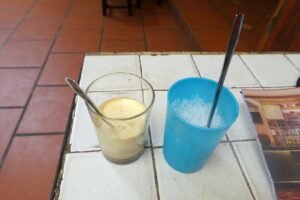
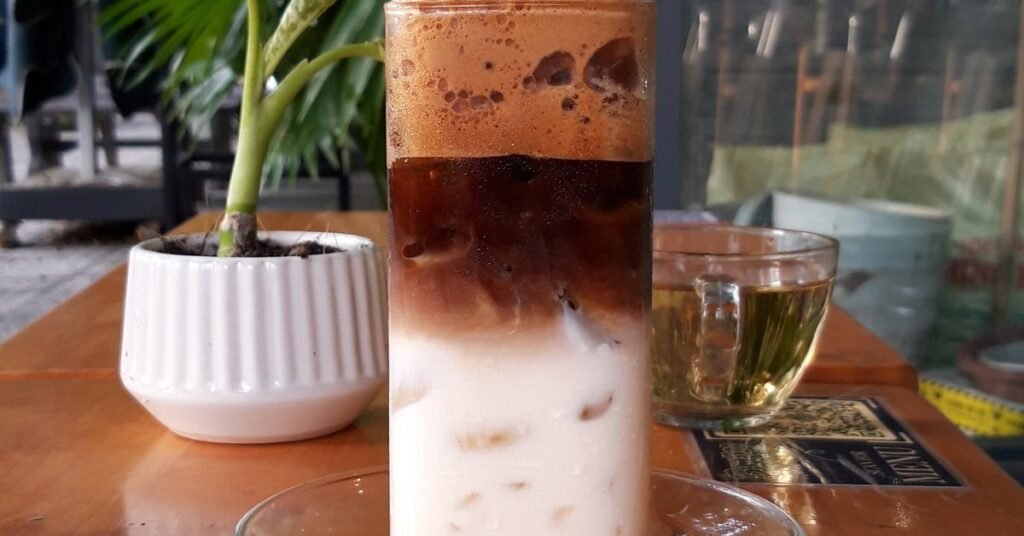
Bac xiu (bạc xỉu) is Saigon’s milk-first version of Vietnamese iced coffee: milk fills most of the glass, in current recipes chiefly fresh milk sweetened with a few spoonfuls of condensed milk, and a smaller share of phin-brewed coffee goes in on top. Its name is a clipped form of bạc tẩy xỉu phé, a phrase from Saigon’s Chinese community that describes a glass of milk with a splash of coffee. Next to cà phê sữa đá it is sweeter and far less bitter, but it is not reliably lower in caffeine, since several published recipes use a full phin of coffee.
What is bac xiu? The name and where it comes from
Bạc xỉu belongs to the south. The Viet Nam National Authority of Tourism’s website calls Ho Chi Minh City, which many still call Saigon, its birthplace, and Saveur calls it “the sweeter, milkier Saigon remix” of cà phê sữa đá.
Vietnamese outlets mostly agree on the long name. Thanh Niên and Phụ nữ mới both read tẩy as the glass, xỉu as a little and phé as coffee, but split on bạc: milk for Thanh Niên, a mispronounced bạch, meaning white, for Phụ nữ mới. Vicky Pham, a home cook who shares Vietnamese recipes online, and Điện Máy Xanh, an appliance retailer with a recipe section, name Cantonese as the source language; Thanh Niên and Phụ nữ mới say only Chinese. Spellings vary too: Tuổi Trẻ News wrote the iced version as “bac siu da.”
Accounts of the origin differ on the date. The Michelin Guide credits Chinese residents of Saigon’s Chinatown in the early 20th century, while Phụ nữ mới says the popular explanation places the name around the middle of the century in Chợ Lớn, the area where many of the city’s Chinese lived. The Michelin Guide passes on a story that the drink’s Chinese makers raised the share of milk to win over women and children who found black or milk coffee too bitter; Điện Máy Xanh tells the same story and adds that fresh milk was expensive at the time. Fresh milk is a later addition, according to Saveur; the original drink was hot water with a little coffee, whitened and sweetened with condensed milk. Chợ Lớn’s cafés served it hot in the morning with breakfast staples such as bánh tiêu, Phụ nữ mới recalls.
English speakers often know it as Vietnamese white coffee, which The Takeout explains by the amount of fresh milk in the glass. Malaysia’s Ipoh white coffee is a different drink, served with condensed milk but made from beans roasted with margarine, says the Malaysia Airlines magazine Going Places.
Bac xiu vs cà phê sữa đá vs cà phê đen đá
All three start from the same phin; as Nguyen Coffee Supply puts it, what changes is what joins the coffee in the glass. Điện Máy Xanh publishes recipes for both milk drinks, which allows a like-for-like comparison.
| Per glass | Bạc xỉu | Cà phê sữa đá | Cà phê đen đá |
|---|---|---|---|
| Coffee | 30 ml of brewed coffee (Điện Máy Xanh); a full phin, 2 tablespoons of grounds with 4 oz of water (Tu David Phu) | 50 ml of phin concentrate (Điện Máy Xanh); a phin of 10 to 14 g of grounds (Saveur, Nguyen Coffee Supply) | The same phin coffee, served black (Nguyen Coffee Supply) |
| Sweetened condensed milk | 2 to 3 tablespoons, 30 to 45 ml (Điện Máy Xanh, Vicky Pham, Tu David Phu) | 1 to 3 tablespoons (Saveur, Nguyen Coffee Supply); 40 ml (Điện Máy Xanh) | None; Znews suggests cane or rock sugar |
| Fresh milk | 100 ml (Điện Máy Xanh) to 4 oz, about 120 ml (Tu David Phu) | None | None |
| Milk to coffee, by volume | About 4.3 to 1 (Điện Máy Xanh); about 1.4 to 1 (Tu David Phu) | About 0.8 to 1 (Điện Máy Xanh) | No milk |
| Estimated caffeine | With a full phin, the same as cà phê sữa đá; with Điện Máy Xanh’s 30 ml, about 40 percent less than its cà phê sữa đá, if brewed alike | About 70 to 120 mg (arabica) or 100 to 220 mg (robusta) for 10 to 14 g of grounds | The same as cà phê sữa đá for the same dose |
How the caffeine was estimated. No source consulted here measured these drinks, so the figures are computed estimates. In a 2013 comparison of nine brewing methods in European Food Research and Technology, Swiss researchers found that espresso machines and drip brewers extracted 0.69 to 0.86 percent of the grounds’ weight as caffeine, about 7 to 8.6 mg per gram, from a Guatemalan coffee (about 96 percent of Guatemala’s crop is arabica in USDA’s 2026/27 forecast). Times 10 to 14 g, that is about 70 to 120 mg. Robusta brews carry about 1.4 to 1.8 times as much caffeine, a 2021 review in Foods found; applying that range puts an all-robusta phin at about 100 to 220 mg. USDA FoodData Central lists zero caffeine for sweetened condensed milk and whole milk; its brewed coffee works out to about 95 mg per 8 fl oz cup.
Is bac xiu strong?
In flavor, no. Tasting Table finds it creamy and frothy with hardly any bitterness, and the national tourism site calls it a favorite of teenagers not yet used to bitter robusta.
In caffeine, it depends on the coffee, because milk adds none. Chef Tu David Phu writes that his bạc xỉu has less caffeine than cà phê sữa, yet his recipe drips 2 tablespoons of grounds with 4 ounces of water, the standard phin dose in Nguyen Coffee Supply’s recipe (for cà phê sữa đá it suggests a little more coffee or a little less water), so with the same coffee the caffeine is about the same. Versions that pour less of the same brew, like Điện Máy Xanh’s 30 ml against the 50 ml in its cà phê sữa đá, come in lower in proportion. For a milder glass, cut the coffee rather than adding milk.
Bac xiu recipe
This recipe card is compiled from published recipes: the proportions follow Chef Tu David Phu’s and Điện Máy Xanh’s, and the layering follows Vicky Pham’s. For phin technique, see how to make Vietnamese iced coffee.
Makes: 1 tall glass of about 16 oz, ice included. Time: about 15 minutes.
- 2 tablespoons ground coffee for a phin, 10 to 14 g depending on whose conversion you follow. Robusta is the traditional choice; see the guide to Vietnamese coffee beans.
- 4 oz (120 ml) water, just off the boil
- 2 to 3 tablespoons sweetened condensed milk
- 4 oz (120 ml) whole milk, or another unsweetened fresh milk
- 1 to 1 1/2 cups of ice
- Brew the coffee. Set the phin over a cup and add the grounds. Dampen them with a little of the hot water, let them bloom for 20 to 30 seconds, then top up the chamber; the drip takes about 5 minutes.
- Build the milk base. Combine the two milks in the glass first, condensed milk at the bottom and fresh milk over it, stirred until even. Chef Tu instead shakes both milks and 1/2 cup of ice together in a cocktail shaker.
- Add ice. Pack the glass with it.
- Froth the coffee, if you like. Whip it with a milk frother or small whisk, or shake it with ice.
- Pour slowly. Let the coffee run over the ice so it settles on the milk as a darker layer.
- Stir, taste and adjust. Mix the layers before drinking. The Michelin Guide stresses that balance matters here, so correct it at the end: more coffee if the glass is cloying, more milk if it is bitter.
Variations
- Hot (bạc xỉu nóng): Điện Máy Xanh heats 40 ml of water with 30 ml each of fresh and condensed milk and 5 ml of coconut milk until it barely simmers, pours it over another 20 ml of condensed milk in the cup, then floats frothed coffee from a 20 g phin on top. The Takeout says the drink was first served hot.
- By the batch: Vicky Pham’s make-ahead version brews 120 g of grounds in 2 quarts of water taken off the boil, steeped 5 minutes, then strained and refrigerated. Each glass takes 1/2 cup.
- Espresso: Vicky Pham suggests two shots in place of the brewed coffee, and two Hanoi cafés in Vietcetera’s 2021 roundup, V60+ Coffee and Gạo Cafe, used machine-extracted coffee.
- Sock filter: Thanh Niên wrote in 2021 that the Chinese community usually brews coffee, bạc xỉu included, through a cloth filter, hence the names cà phê vợt and “sock coffee.” In Saigon’s cafés the method has grown rare, Saveur says; one survivor is Cà Phê Vợt in Phú Nhuận, in the same family’s hands for over 70 years, where bạc xỉu still comes from the sock.
- Whipped coffee foam: 7 Leaves Cafe, a chain that began in Southern California and lists 43 stores, tops its Bac Xiu with whipped coffee foam over a three-bean blend, whole milk and condensed milk.
Frequently asked questions
What is the difference between bac xiu and Vietnamese iced coffee?
The proportions. In cà phê sữa đá, Vietnamese iced coffee, the coffee dominates and condensed milk sweetens it. Bạc xỉu reverses the balance: milk makes up the bulk of the glass, in the recipes compared here fresh milk with 2 to 3 tablespoons of condensed milk stirred in, and the coffee is the smaller part. Tuổi Trẻ News described it as “a somewhat upside down ca phe sua da.”
Is bac xiu sweet?
Yes. The national tourism site names it the pick for a sugar rush. On USDA FoodData Central figures, condensed milk carries about 10 g of sugar per tablespoon, so the 3 tablespoons in Chef Tu David Phu’s recipe hold about 31 g, and his 4 ounces of whole milk add about 6 g of milk sugar. Two tablespoons of condensed milk cut the first figure to about 21 g.
Is bac xiu a latte?
Close in spirit: Vicky Pham likens it to a Vietnamese latte, and Tasting Table compares it to an iced latte. But USDA’s survey recipe for a nonfat latte is just espresso and milk, while bạc xỉu traditionally starts with phin coffee and is sweetened with condensed milk.
What does bac xiu mean in English?
It is short for bạc tẩy xỉu phé, which Saveur glosses roughly as “a glass of white with a little coffee.” English speakers often know it as Vietnamese white coffee.
What does bac xiu taste like?
Sweet, creamy milk first, coffee second. In The Takeout’s tasting only a trace of bitterness comes through a glass led by fresh milk and sugar, and Tasting Table notes “a pleasantly oily mouth-feel” that it puts down to the fat.
Sources
- Saveur, 10 Vietnamese Coffee Drinks and Where to Try Them in Saigon, August 31, 2026
- Saveur, Vietnamese Iced Coffee, updated August 31, 2026
- Viet Nam National Authority of Tourism, 5 fantastic Vietnamese coffees, updated November 4, 2026
- Michelin Guide, A Guide to Vietnamese Coffee, March 30, 2024
- Tuổi Trẻ News, ‘Ca phe sua da’: A classic drink of Saigon, November 20, 2017
- Thanh Niên, Pha bạc xỉu bằng vợt tại nhà ngon như ở tiệm, July 11, 2021
- Phụ nữ mới, Vì sao gọi là bạc xỉu?, August 5, 2026
- Điện Máy Xanh, Bạc xỉu là gì? Nguồn gốc và cách làm bạc xỉu thơm ngon đơn giản tại nhà, March 18, 2021
- Điện Máy Xanh, Cách pha cà phê bạc xỉu nóng đơn giản tại nhà chuẩn vị ngoài hàng, updated March 5, 2024
- Điện Máy Xanh, 2 Cách pha cà phê sữa đá thơm ngon đúng điệu mà bạn nên biết, updated November 19, 2021
- Znews, Mẹo pha cà phê ngon, March 21, 2015
- Tu David Phu, Bạc Xỉu [Saigon Style Coffee], May 5, 2021
- Vicky Pham, Vietnamese White Coffee with Fresh Milk (Bạc Xỉu), March 22, 2026
- Tasting Table, Bạc Xỉu: The Lesser-Known Vietnamese Coffee, February 23, 2023
- The Takeout, 10 Vietnamese Coffee Drinks You Can Easily Make At Home, August 6, 2025
- Nguyen Coffee Supply, How to Make Vietnamese Coffee (Hot or Iced), September 24, 2021
- Vietcetera, Enjoy The Autumn Aroma In Hanoi With Bạc Xỉu Delivered To Your Door, October 7, 2021
- 7 Leaves Cafe, Menu and Store Locations pages, accessed November 4, 2026
- Malaysia Airlines, Going Places, Malaysia icon: Ipoh white coffee, November 2025
- Gloess and others, Comparison of nine common coffee extraction methods, European Food Research and Technology, 2013
- Olechno and others, Influence of Various Factors on Caffeine Content in Coffee Brews, Foods, 2021
- USDA FoodData Central: SR Legacy records 171890, 171275 and 171265, April 1, 2019; FNDDS record 2710387, October 31, 2024
- USDA Foreign Agricultural Service, Coffee: World Markets and Trade, July 2026
Part of the Vietnamese coffee guide.
Featured image: Iced bạc xỉu at a cafe in Da Nang, November 2023: milk below, coffee above and a foam cap. Photo: Klientos, CC BY-SA 4.0, via Wikimedia Commons (cropped).