Most Vietnamese coffee beans are robusta (Coffea canephora), the species behind about 97 percent of the country’s harvest, and they are usually roasted dark. A small arabica crop grows in mountain areas from Sơn La in the northwest to Lâm Đồng in the Central Highlands, and two rarer kinds are sold on their own: culi, the round single-seed bean also called a peaberry, and liberica or excelsa, which has the Vietnamese name jackfruit coffee. Some well-known Vietnamese ground coffees also contain more than coffee, so the ingredient list matters as much as the bean.
What beans are used in Vietnamese coffee?
In its July 2026 outlook, the US Department of Agriculture put Vietnam’s 2026/27 crop at 32.5 million bags (60 kg each): 31.4 million robusta and 1.1 million arabica. The USDA reports only those two categories.
Robusta
In the cup, World Coffee Research says, robusta is often more bitter and fuller-bodied than arabica, with less acidity. Saveur has called Vietnamese robusta nutty and cocoa-like. It also carries more caffeine; the numbers are in the guide to why Vietnamese coffee is so strong. Most Vietnamese robusta descends from Javanese stock, and by 2019 growers favored a few high-yield local clones, chiefly TR14, TR15 and TRS1. It is the traditional bean for cà phê sữa đá, and SBS Food notes that Vietnam’s instant coffee exports rely on it too.
Arabica
Arabica reached Vietnam first, carried by French missionaries in 1857, according to a 2019 country profile that the Vietnam Coffee-Cocoa Association (VICOFA) prepared with support from the International Coffee Organization. Catimor, bred from Caturra and the robusta-influenced Timor hybrid, made up almost 99 percent of Vietnamese arabica in the same profile. Local breeders have been developing replacements, and some of the new varieties have passed 80 points on the Specialty Coffee Association scale, the specialty grade. Small amounts of Bourbon, sometimes sold as “moka,” come from the Đà Lạt area. Arabica offers more acidity and fruit than robusta, and Nguyen Coffee Supply recommends its all-arabica Moxy for pour-over.
Culi (peaberry)
Peaberries are small, dense and round, with none of the flat face a normal coffee bean gets from growing pressed against a twin seed. They come from the roughly 5 percent of cherries, by Britannica’s count, that develop only one seed. In Vietnamese the round bean is cà phê culi. Since culi describes shape rather than species, it can be robusta or arabica. Opinions split on taste: Britannica says some drinkers find peaberries sweeter, while a 2026 Starbucks explainer calls the difference structural rather than sensory and says a few peaberries in a bag will probably go unnoticed.
Excelsa and liberica (cà phê mít)
The French brought excelsa to Vietnam in 1908, along with robusta, the VICOFA profile says. PROSEA, a reference on Southeast Asian plants, gives cà phê mít (jackfruit coffee) as one of the Vietnamese names for liberica, and in a 2025 Saveur story a farmer’s relative in Vietnam used the same name. Botanists have usually filed excelsa under Coffea liberica as a variety. A 2025 Nature Plants study led by Aaron Davis of Kew instead treats it as its own species, Coffea dewevrei, and estimates that world output of the two is probably under 1,000 metric tons a year, at most about 0.01 percent of global coffee exports. Vietnam is one of the places where excelsa output is now growing, the study adds, as a complement to robusta. PROSEA calls liberica more bitter than arabica or robusta and excelsa milder, yet in February 2026 Coffee Review scored a Quảng Trị liberica at 93 points, with notes of butterscotch and baking chocolate.
| Bean | Species | Where it grows in Vietnam | Flavor | Typical use |
|---|---|---|---|---|
| Robusta | Coffea canephora | Central Highlands: Đắk Lắk, Lâm Đồng, Gia Lai and neighbors | Bitter, heavy, low in acidity; often nutty or cocoa-like | Phin coffee with condensed milk, blends, instant coffee |
| Arabica | Coffea arabica, mostly Catimor | Sơn La, Lâm Đồng (Đà Lạt, Cầu Đất), Quảng Trị | Lighter, fruitier, more acidic | Blends, pour-over, single origins |
| Culi | Robusta or arabica peaberry | Wherever robusta or arabica grows | Disputed; some find it sweeter | Sold as separate culi coffees |
| Excelsa, liberica | Coffea liberica; excelsa proposed as C. dewevrei | Small plantings, including Quảng Trị | Described as anything from bitter to very sweet | Specialty roasters, blends |
Vietnam’s place in world coffee
Vietnam ranks second among coffee-producing countries. Only Brazil grows more: 71.9 million bags in the same USDA forecast, out of a forecast world total of 189.7 million. In robusta Vietnam leads: its 31.4 million bags are about 37 percent of the 83.8 million forecast worldwide, ahead of Brazil’s 24.4 million. The growth has been steep. The VICOFA profile records a 1986 harvest of 18,400 metric tons, a little over 300,000 bags.
Where Vietnamese coffee grows
- Central Highlands: the heart of the robusta crop. VICOFA names Đắk Lắk, Lâm Đồng, Đắk Nông, Gia Lai and Kon Tum as the main coffee provinces. Buôn Ma Thuột in Đắk Lắk is often called the country’s coffee capital, and its name is one of the regional coffee geographical indications the profile lists.
- Lâm Đồng: grows both robusta and arabica, the arabica around Đà Lạt. Cầu Đất, in the Đà Lạt area, is another listed geographical indication.
- Sơn La: the northwestern province that completes the profile’s list of three coffee geographical indications. At a June 2026 event covered by the Vietnam News Agency, provincial officials described it as the country’s largest arabica region, with close to 34,000 hectares planted with coffee.
- Quảng Trị and Nghệ An: central provinces where, according to VICOFA, arabica planting has been supported. Quảng Trị also grew the liberica Coffee Review scored.
Older labels may not match today’s map. A 2025 reform cut Vietnam’s 63 provinces and centrally run cities to 34, with the new units operating from July 1, 2025: Đắk Nông now belongs to Lâm Đồng, Phú Yên to Đắk Lắk, and Kon Tum to Quảng Ngãi. Sơn La was unchanged.
How Vietnamese coffee is roasted
Dark roasts are the norm. According to Sahra Nguyen, founder and head roaster of the Brooklyn importer Nguyen Coffee Supply, butter is the traditional roasting fat in Vietnam, and most beans finish medium-dark to dark, a few as far as French roast.
Some blends add more than butter. Trung Nguyên posts its product self-declarations (bản tự công bố sản phẩm) on its website, and the 2026 versions for its Sáng Tạo (Creative) 1 to 5 ground coffees give coffee as 80 to 82 percent of the contents. The rest, in the order declared, is soybeans, brown sugar syrup, a butter substitute made from vegetable oil, synthetic flavoring and butter. Even its whole-bean Culi Robusta lists 92 percent robusta, with the butter substitute, sugar syrup, flavoring and butter making up the balance. Other brands avoid additives entirely: Nguyen Coffee Supply says it roasts only coffee, with no butter or flavorings.
How to read a Vietnamese coffee label
- Check the ingredient order. On bags sold in the US, federal rules require ingredients to be listed by weight, heaviest first, so whatever comes second, such as soybeans, is the largest addition.
- Look for a percentage. “Coffee 80%” means a fifth of the contents is something else.
- Learn six Vietnamese words. Cà phê vối is robusta and cà phê chè is arabica; đậu nành is soybean, đường is sugar, bơ is butter and hương liệu is flavoring.
- Read the allergen line. Trung Nguyên’s declarations flag soy and milk, the giveaway for soybeans and butter.
- Find the species. A blend should name robusta and arabica, ideally with proportions. “Chicory” means a coffee and chicory blend rather than pure coffee.
How to choose and buy Vietnamese coffee beans
- Pick the bean first. Choose all robusta for the traditional cup with condensed milk. Blends are common: a 2012 study of Vietnamese coffee brands notes that most commercial brands there combine arabica and robusta. All arabica gives a lighter, more acidic cup.
- Buy whole beans if you can grind. A Specialty Coffee Association literature review explains that grinding increases the surface exposed to air and so speeds staling. Pre-ground coffee sold as universal or medium is fine in a phin, Copper Cow Coffee says, while whole beans should be ground medium-fine; the steps are in the guide to how to use a phin filter.
- Look for a roast date. The same review cites research showing that freshness drops fastest in the first month of storage. A shelf-life date measures something else: Trung Nguyên gives its Sáng Tạo ground coffees 24 months from the production date. On Vietnamese bags, ngày sản xuất is the production date and hạn sử dụng the use-by date.
- Store it airtight. The SCA review names oxygen as the biggest driver of staling, so keep beans sealed in a cool, dark place.
Brand notes
- Trung Nguyên was founded in Buôn Ma Thuột in 1996. Alongside the ground Sáng Tạo (Creative) line, it sells culi robusta and culi arabica as whole beans. The declarations above cover the versions registered in Vietnam, and the online retailer Crema lists the same 80 percent formula for the export Creative 1 it sells in Europe. Recipes can still differ by market, so read the ingredients on the bag you buy.
- Nguyen Coffee Supply was founded in 2018 by Sahra Nguyen and roasts in Brooklyn. Saveur described it in 2019 as the first American company dealing only in Vietnamese beans. Its suppliers include a women-owned cooperative in Sơn La and a family farm in the Central Highlands, and it sells all-robusta, all-arabica and blended coffees, whole bean or ground.
- Café du Monde traces its New Orleans coffee stand to 1862. Its signature Coffee and Chicory blend is 4 parts coffee to 1 part roasted chicory root, and like the company’s chicory-free French Roast, it is sold ground only. A company vice president, Burt Benrud, told Country Roads magazine that Vietnamese immigrants hired at the café in the 1970s and 1980s took it with condensed milk and passed the habit to relatives nationwide. It is now a common choice for Vietnamese iced coffee in Vietnamese restaurants across the US.
A note on weasel coffee (cà phê chồn)
The name promises beans recovered from civet droppings, yet some versions never go near the animal. In 2011 Smithsonian magazine reported that the Hanoi café Café Mai and the roaster Trung Nguyên were reproducing the flavor with artificial fermentation instead. Where live civets are used, the welfare record is poor. Every one of the 16 Bali plantations assessed for a 2016 paper in Animal Welfare kept its civets in very poor housing, and a 2024 survey of 29 Bali plantations found no civet whose care met all five welfare freedoms. Both studies were in Indonesia.
The phin, the classic drinks and Hanoi’s café culture are covered in the Vietnamese coffee guide.
Frequently asked questions
Is Vietnamese coffee robusta or arabica?
Mostly robusta. Of the 32.5 million bags the USDA forecasts for Vietnam in 2026/27, 31.4 million are robusta and 1.1 million arabica, and many commercial brands blend the two.
What is culi coffee?
Culi means peaberry, a bean that grew as the only seed in its cherry. With no second seed beside it, the bean grows rounded all over. About 5 percent of cherries produce one, and culi can be robusta or arabica.
Can you use regular coffee beans for Vietnamese coffee?
Yes. Supermarket coffee sold pre-ground as medium or universal is fine in a phin, and whole beans should be ground medium-fine. Dark and medium-dark roasts are traditional, and robusta, alone or as most of a blend, gives the bitter base that holds its own against condensed milk. A medium roast or more arabica makes a lighter, less intense cup.
Why do some Vietnamese coffees taste like chocolate or butter?
Part of it is robusta itself, which writers often describe in terms of cocoa and nuts. The rest can come from the recipe: some blends, including Trung Nguyên’s Sáng Tạo ground coffees as registered in Vietnam, add butter, sugar syrup and flavorings, and Café du Monde credits its chicory with an almost chocolate note.
Is Café du Monde a Vietnamese coffee?
No. Café du Monde is a New Orleans company whose coffee stand opened in 1862, and its signature blend mixes coffee with roasted chicory root; the company’s coffee page and FAQ name no bean origin. The chicory blend became a fixture in Vietnamese American homes and restaurants after Vietnamese immigrants in New Orleans took it up in the 1970s and 1980s.
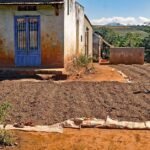
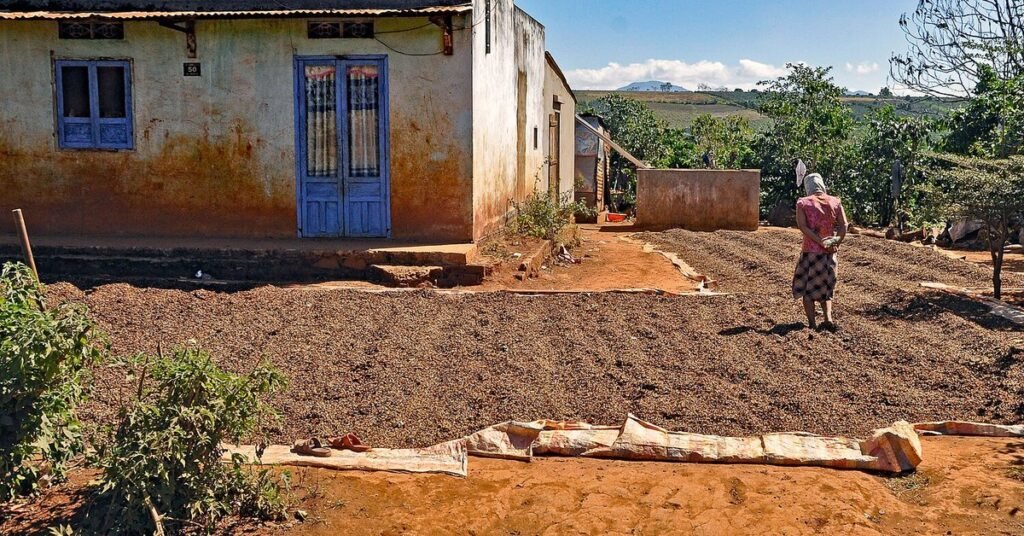
Featured image: Coffee beans drying in the sun near Da Lat, Vietnam. Photo: P. Hughes, CC BY 4.0, via Wikimedia Commons (cropped).