
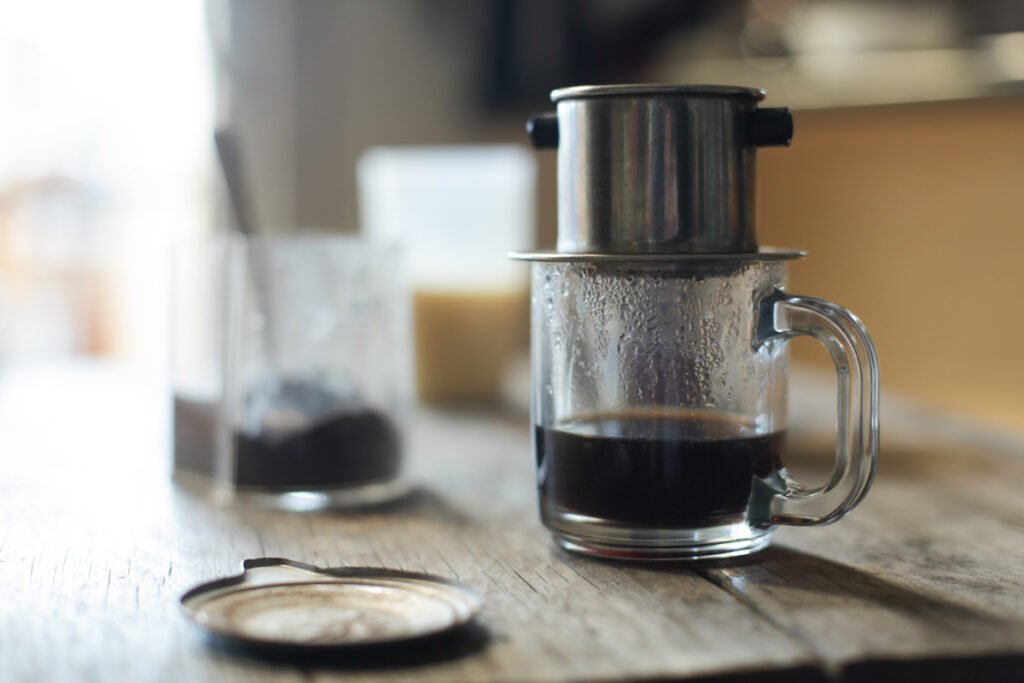
Vietnamese iced coffee, cà phê sữa đá, is strong dark coffee dripped slowly through a small metal filter onto sweetened condensed milk, stirred, and poured over ice. You need about five minutes, four ingredients and a phin, the little drip filter every Vietnamese kitchen has. Here is how to make it properly, why it tastes the way it does, and how to fix the two problems almost everyone hits the first time.
What you need
For one glass:
- 2 tablespoons (about 14 g) of ground coffee, medium-fine: coarser than espresso and finer than pour-over, close to a moka pot setting
- 1 to 2 tablespoons of sweetened condensed milk: 1 for a strong, less sweet glass, 2 for the classic café version
- About 100 ml (3.5 oz) of water, just off the boil, around 95°C (205°F)
- A glass full of ice
- A phin filter, sized to sit on top of your cup (new to phins? see how to use a phin filter)
Which coffee? Vietnam is the world’s second-largest coffee producer after Brazil, and most of what it grows is robusta, a bean that is more bitter, more chocolatey and higher in caffeine than the arabica most Western cafés use. A Vietnamese brand such as Trung Nguyên gets you closest to the real thing. In the United States, many Vietnamese families use Café Du Monde, a New Orleans coffee blended with chicory, which gives a similar dark, slightly sweet depth. Any dark roast will work, but a light, fruity arabica will taste thin against the condensed milk.
How to make Vietnamese iced coffee, step by step
- Put the condensed milk in the cup. Use a heatproof glass or cup that the phin can sit on securely. The milk goes in first so the coffee drips straight onto it.
- Add the coffee to the phin. Take off the lid and the press, spoon in the grounds, and shake the chamber gently so they settle flat.
- Put the press back on lightly. If your phin has a screw-down press, turn it until it just touches the coffee, then back it off a little. If it has a gravity press, simply rest it on top. Pressing hard makes the coffee drip too slowly.
- Bloom the coffee. Pour in about 20 to 30 ml of hot water, just enough to wet the grounds, and wait 30 to 60 seconds. The grounds swell and release gas, which gives a more even extraction.
- Fill and cover. Pour in the rest of the water to the top of the chamber and put the lid on to keep the heat in.
- Let it drip. It should take about 4 to 6 minutes for the water to pass through, at a pace of a drop or two per second. This slow drip is the whole point: it makes a small, very concentrated cup.
- Stir and pour over ice. Lift the phin off onto its lid, stir the coffee into the condensed milk until it is one even caramel color, then pour it over a glass full of ice. Stir again and drink it while the ice is still big.
Fixing a phin that drips too fast or too slow
Almost every first attempt goes wrong in one of two ways, and both come down to how tightly the water can move through the coffee.
- It drips straight through in under two minutes. The coffee will taste watery and sour. Use a slightly finer grind, add a little more coffee, or turn a screw press down a quarter turn more. A gravity press does not adjust, so with that kind of phin the grind is your only control.
- It barely drips at all, or stops. The coffee will taste harsh and bitter, and you will lose heat. Loosen the press, or use a coarser grind. Very fine, espresso-style grounds clog a phin, which is why pre-ground espresso coffee rarely works.
Once you find the setting that gives you a 4 to 6 minute drip, write it down. It will be the same every time with the same coffee.
Why it is made this way
Coffee arrived in Vietnam with the French in the nineteenth century. Fresh milk was scarce and hard to keep in the tropical heat, so sweetened condensed milk, which keeps for months unopened, became the standard partner for coffee. The sweetness also balances the bitterness of robusta. The phin makes a small amount of very strong coffee, which is exactly what you want when it will be diluted by melting ice.
Is it stronger than normal coffee? Usually, yes. Robusta brews with roughly 1.4 to 1.8 times the caffeine of arabica, and a phin extracts a concentrated cup, so a glass of cà phê sữa đá can deliver a strong dose in a small volume. For the numbers, see why Vietnamese coffee is so strong. If you are sensitive to caffeine, start with a smaller amount of coffee.
Variations worth trying
- Cà phê đen đá: black iced coffee. Skip the condensed milk and sweeten with sugar, or not at all.
- Bạc xỉu: a milkier version popular in Saigon, with much more milk than coffee. Stir 2 to 3 tablespoons of condensed milk into about 120 ml (4 oz) of fresh milk, add ice, and pour the coffee on top. The bạc xỉu guide has the full recipe.
- Cà phê sữa nóng: the same coffee served hot. Set the cup in a bowl of hot water while it drips so it does not cool down.
- Cà phê trứng (egg coffee): Hanoi’s famous version, with egg yolk whipped with condensed milk into a thick foam on top. It is a dessert as much as a drink. The usual story credits Nguyễn Văn Giảng, who was working at the Metropole hotel in the 1940s, and his family’s Café Giảng still serves it on Nguyễn Hữu Huân, the same street as Café Lâm.
- Cà phê cốt dừa (coconut coffee): coconut cream and condensed milk blended with ice into a slush, with the phin coffee poured alongside. See the full Vietnamese coconut coffee recipe.
Frequently asked questions
What is the ratio of coffee to condensed milk in Vietnamese iced coffee?
For one glass, brew about 2 tablespoons (14 g) of ground coffee with roughly 100 ml (3.5 oz) of water and drip it onto 1 to 2 tablespoons of sweetened condensed milk. One tablespoon gives a stronger, less sweet glass; two gives the classic café version.
Can I make Vietnamese iced coffee without a phin?
Yes. Brew a small, strong cup with an AeroPress, a moka pot or a French press using about twice your usual amount of coffee for the water, then stir it into the condensed milk and pour over ice. It will taste close, though the phin’s slow drip gives a smoother, heavier body.
Can I use regular milk instead of condensed milk?
You can, but it will be a different drink. Condensed milk adds sweetness and a thick, creamy texture that fresh milk cannot. If you want less sugar, use less condensed milk rather than swapping it out.
How much coffee should I use for a large glass?
Phins come in sizes. For a bigger phin and a large glass, use about 20 to 25 g of coffee and around 150 ml of water, and expect the drip to take a minute or two longer.
Why does my Vietnamese coffee taste sour?
Sourness almost always means the water ran through too fast. Grind a little finer or press a little tighter so the drip takes at least four minutes.
Part of the Vietnamese coffee guide.
Featured image: Vietnamese coffee dripping through a phin filter. Photo: HungryHuy, CC BY 2.0, via Wikimedia Commons.