Cappuccino vs latte is a question of proportion: the same espresso meets less milk and deeper foam in a cappuccino, which is why its coffee flavor comes through more strongly. A check on November 9, 2026 of the nutrition figures published by 12 chains that sell both drinks found the latte higher in calories and protein at 11 of them, with a median gap across all 12 of about 32 calories and 2.4 g of protein; Panera lists the two drinks as identical. Caffeine is another matter: three of the chains list it for both drinks, two showing equal amounts and one twice as much in the cappuccino.
The difference between latte and cappuccino at a glance
| Cappuccino | Latte | |
|---|---|---|
| Foam depth | At least 1 cm (about 0.4 in) | About 0.5 cm (about 0.2 in) |
| Traditional size | 150 to 180 ml (5 to 6 oz); a 150 to 160 ml cup in the Italian certification | No fixed size; 236 to 340 ml (8 to 12 oz) is typical today |
| Size at chains | Same menu labels as the latte; Starbucks runs from 8 to 20 fl oz | More weight or volume than the cappuccino at all 5 chains that publish an amount beyond the cup size; Panera lists both as 16 fl oz servings |
| Espresso to milk | 1 to 4 in the Italian certification, by cold milk volume | About 1 to 5 by weight in USDA’s survey recipe |
| Milk temperature | About 55 °C in the Italian certification | No rule; 60 to 66 °C in Breville’s guide, 55 to 60 °C in cafés per a world latte art champion |
| Taste | More coffee up front, airy top | Milder and creamier |
| Calories, same menu size | Lower at 11 of 12 chains checked | 6 to 90 calories higher at those 11; equal at Panera |
| Caffeine | Depends on the shot count | Depends on the shot count |
What is a cappuccino? Standards and their wording
Italy’s Istituto Nazionale Espresso Italiano, a Brescia institute behind the certified Espresso Italiano label, added a certified cappuccino in 2006. Its definition reads: “il cappuccino di qualità e rispettoso della tradizione è composto da 25 ml di espresso e da 100 ml di latte montato con vapore.” The institute’s English version says “a high quality cappuccino that abides by tradition is made of 25 ml espresso and 100 ml steam-foamed milk.”
Its brochure supplies the working numbers: “A hundred millilitres of cold milk (3-5°C) are steamed until they achieve a volume of approximately 125 ml and a temperature of approximately 55°C.” That goes onto the espresso in a cup holding 150 to 160 ml, filled to the brim and domed on top. Only fresh cow’s milk qualifies, with at least 3.2 percent protein and 3.5 percent fat.
Competition rules set numbers too, for a while. The World Barista Championship’s 2015 rulebook calls a cappuccino “a coffee and milk beverage that should produce a harmonious balance of rich, sweet milk and espresso,” made from one single shot, textured milk and foam, in a cup of 150 to 180 ml that the drink must fill. Judges probed it with a spoon, and a “very good” mark took at least 1 cm. The 2016 rules replaced it with a “milk beverage” under 240 ml, ending what Daily Coffee News called a 15-year-old cappuccino course. The 2026 rules keep the new term, drop the volume limit and never use the word cappuccino.
The Specialty Coffee Association often gets the credit for these figures. Perfect Daily Grind wrote in July 2026 that it defines a cappuccino as 150 to 180 ml with a single shot and at least 1 cm of microfoam, and the appliance maker Breville quotes a 5 to 6 oz definition in the association’s name. Those figures match the championship’s old rule. The association’s own list of published standards, read on November 9, 2026, covers coffee evaluation, equipment and training and names no milk drink.
| Source | Espresso | Milk and total | Foam | Temperature |
|---|---|---|---|---|
| Istituto Nazionale Espresso Italiano, certified cappuccino | 25 ml | 100 ml cold, about 125 ml steamed; 150 to 160 ml cup | No depth given; domed top | Milk about 55 °C |
| World Barista Championship, 2015 cappuccino rule | 1 single shot, 30 ml give or take 5 ml | Cup of 150 to 180 ml, filled | At least 1 cm for a “very good” mark | “Immediately consumable” |
| World Barista Championship, 2026 milk beverage | 1 single shot, around 30 ml | No volume | No depth; latte art or a central white circle allowed | “Immediately consumable” |
| Specialty Coffee Association, as reported by Perfect Daily Grind | Single shot | 150 to 180 ml | At least 1 cm | Not reported |
Is there a formal latte standard?
None turned up in the documents read for this check. The Italian institute’s brochure covers espresso and cappuccino only. In the 2026 championship rulebook, “latte” occurs only inside the phrase “latte art.” The association’s standards list has no drink recipes. In its July 2026 look at the issue, Perfect Daily Grind found no agreed rule either, only local habit and what customers expect.
What exists is custom. That magazine puts today’s latte at 236 to 340 ml (8 to 12 oz) with around 0.5 cm of microfoam, Breville starts it at 6 oz with about 0.2 inches, and Merriam-Webster asks only for espresso plus steamed or hot milk. Absence from these documents does not prove that no standard exists anywhere.
Latte vs cappuccino: what 12 chains publish
To put a number on the difference between cappuccino and latte in real orders, each row compares one size, with the milk the chain’s data uses by default or, where it lists several, the one named. Figures are the chains’ own, read on November 9, 2026.
| Chain, market, size | Milk as published | Cappuccino | Latte | Latte minus cappuccino |
|---|---|---|---|---|
| Starbucks, US, Grande (16 fl oz) | 2% | 140 cal, 9 g protein | 190 cal, 13 g protein | 50 cal, 4 g |
| Dunkin’, US, Medium | Whole | 120 cal, 6 g protein | 170 cal, 9 g protein | 50 cal, 3 g |
| McDonald’s, US, Medium | Whole | 160 cal, 9 g protein | 190 cal, 10 g protein | 30 cal, 1 g |
| Peet’s, US, Medium | 2% | 140 cal, 9 g protein | 200 cal, 14 g protein | 60 cal, 5 g |
| Caribou Coffee, US, Medium | 2% | 120 cal, 9 g protein | 200 cal, 14 g protein | 80 cal, 5 g |
| The Coffee Bean & Tea Leaf, US, 12 oz | Not stated | 140 cal, 7 g protein (single shot row) | 230 cal, 11 g protein | 90 cal, 4 g |
| Panera Bread, US, 16 fl oz | Not stated | 130 cal, 8 g protein | 130 cal, 8 g protein | 0 cal, 0 g |
| Tim Hortons, Canada, Medium | Not stated | 120 cal, 8 g protein | 140 cal, 10 g protein | 20 cal, 2 g |
| Costa Coffee, UK, Medium | Semi-skimmed, as selected on the page | 140 kcal, 10 g protein | 146 kcal, 11 g protein | 6 kcal, 1 g |
| Pret A Manger, UK, 12 oz | Semi-skimmed | 116 kcal, 8.2 g protein | 136 kcal, 9.5 g protein | 20 kcal, 1.3 g |
| Caffè Nero, UK, Regular | Semi-skimmed | 90 kcal, 6.4 g protein | 123 kcal, 9.1 g protein | 33 kcal, 2.7 g |
| Greggs, UK, Regular | Not stated | 94 kcal, 6.6 g protein | 114 kcal, 7.8 g protein | 20 kcal, 1.2 g |
| Median of the 12 | 31.5 cal, 2.35 g |
Median gaps for fat and sugar were 1.65 g and 3 g. Four things stand out.
- The direction almost never changes, but the size does. The latte led at 11 of 12, yet Costa’s two drinks sit 6 kcal apart and The Coffee Bean’s 90 calories apart. Panera’s guide prints identical rows for the two drinks at both 16 and 20 fl oz, without saying why. The eight North American chains had a median gap of 50 calories, the four British ones 20, though milk and cup sizes differ too.
- A shared size label does not mean a shared amount. Caribou lists 362 g of cappuccino against 456 g of latte at Medium, Costa 332 ml against 352 ml, and Greggs 275 ml against 326 g. Dividing energy per serving by energy per 100 g gives about 294 g against 345 g at Pret, and about 217 g against 296 g at Caffè Nero.
- At the four British chains, the gap is quantity, not richness. Per 100 g or 100 ml the pairs almost match: 42 and 41 kcal at Costa, 39 and 40 at Pret, 41 and 43 at Caffè Nero, 34 and 35 at Greggs. There the cappuccino is not a lighter recipe, just less liquid in the cup. Caribou’s figures do not fit that pattern: its listed weights work out to about 33 kcal per 100 g for the Medium cappuccino against 44 for the latte, and the cappuccino is lower at all four sizes. Caribou does not say why.
- Protein tracks the milk. Espresso contributes next to none (The Coffee Bean lists 0 g in a double), so protein is a fair stand-in for milk. A cappuccino’s protein ran from 64 to 100 percent of the latte’s, with a median of 75 percent. That points to about a quarter less milk in the median case, an estimate limited by rounding to whole grams at most North American chains.
Milk choice can matter as much as the drink. At Peet’s, moving a Medium latte from 2% to whole adds 80 calories, more than the 60 between its 2% latte and 2% cappuccino. At Dunkin’, a Medium latte made with skim (100) comes in under a Medium cappuccino made with whole (120).
Scope of the check. These are the chains checked on November 9, 2026, one size each. Their figures rest largely on standard recipes, not measurements of poured cups. The Coffee Bean’s PDF was created in February 2024 and is still the one its site serves; Tim Hortons’ says July 2026. Caffè Nero prints 123 kcal for its Regular latte beside 533 kJ, which converts to about 127 kcal; the table keeps the printed figure, and using 127 would lift the median to 33.5. Every other value in that latte block, per 100 g included, is the same as in Caffè Nero’s Grande cappuccino block, which prints 127 kcal; the menu does not say why. Compare within a row, since milks differ between rows. One more chain gave no usable pair: Blank Street’s public web menu shows no plain cappuccino and no nutrition figures.
What that means in the cup
Ratios can be worked out only where a source states the inputs, and few do. No chain above publishes its split of liquid milk and foam, so none gets a ratio here.
| Recipe | Espresso | Milk | Espresso to milk |
|---|---|---|---|
| Italian certified cappuccino | 25 ml | 100 ml cold, about 125 ml steamed | 1 to 4 cold, 1 to 5 steamed, by volume |
| World Barista Championship, 2015 cappuccino | About 30 ml | The rest of the cup, about 120 to 150 ml of milk and foam | Between about 1 to 4 and 1 to 5, by final volume |
| USDA survey recipe, cappuccino | 2 fl oz (62 g) | 6 fl oz of 2% milk (183 g), plus 4 fl oz of water (118.5 g) | About 1 to 3, by weight |
| USDA survey recipe, nonfat latte | 2 fl oz (62 g) | 10 fl oz of nonfat milk (305 g) | About 1 to 4.9, by weight |
The two cappuccino rules land close together, at about 1 part espresso to 4 or 5 parts steamed milk and foam. Espresso makes up about 17 percent of the certified Italian drink’s roughly 150 ml. A Starbucks Grande is another drink in scale: 16 fl oz is about three times that institute’s 160 ml cup, and the Doppio that Starbucks lists at 1.5 fl oz would fill about 9 percent of it. A stronger recipe also displaces milk: at 12 oz, The Coffee Bean’s Single cappuccino lists 140 calories and its Double 120.
Which has more caffeine?
With the same shots, neither. In USDA’s survey data each gets a 2 fl oz pour, giving an equal 86 mg for 8 fl oz, since milk adds none. Starbucks agrees: both Grande drinks default to 2 shots and list about 150 mg. So does Panera, at about 126 mg for either drink at 16 or 20 fl oz, the figure it also gives its 2 fl oz espresso. For per-shot figures, see caffeine in espresso vs coffee.
Caribou’s data does not fit that picture. Its Medium cappuccino lists 330 mg against 165 mg for the Medium latte, and the cappuccino is about double at all four sizes. An archived 2019 Caribou PDF also ran higher for the medium cappuccino, 270 mg against 180 mg, and the large, 360 mg against 270 mg, though its small was equal at 180 mg, so the higher figure is not new. Its order pages give no shot count and do not explain why. At 330 mg, one cup is most of the 400 mg a day the FDA cites for most adults. By contrast, the espresso in a certified Italian cappuccino must stay under 100 mg.
Dunkin’s guide has no caffeine column, but its newsroom put cappuccinos at about 120 mg for a small to 250 mg for a large in 2021, and the Center for Science in the Public Interest lists its medium latte or cappuccino together at 166 mg. Peet’s gives about 70 mg per espresso shot and no figure per drink. The other seven chains show no caffeine figure on the pages and PDFs read for this check; Tim Hortons sends customers to its Guest Care team. Shot counts are just as scarce: beyond Starbucks, The Coffee Bean splits its cappuccino rows into Single and Double, and Greggs calls its latte a double shot. So a stronger taste reflects the ratio and says little about caffeine. If the dose matters, ask how many shots go in.
How to tell them apart and how to order
This advice is compiled from the sources above rather than taken from any one of them.
- Look at the top. The institute’s classic version shows a white dome inside a brown ring. A latte’s foam is about half as deep.
- Use a spoon. That is how championship judges checked depth. In CoffeeGeek’s spoon test, good foam smooths over again after a brief rise, neither stiff nor runny. A latte has little to press.
- Lift the cup. At the same menu size, the cappuccino should feel lighter: Caribou’s Medium is 21 percent lighter by listed weight.
- Name the size. A traditional cappuccino is small, and Starbucks’ smallest listed is 8 fl oz, about 240 ml.
- Say wet or dry. Dry means thick foam sitting apart from the coffee. Wet means more steamed milk folded in, which pushes the drink toward a latte.
- Abroad, use the full name. Latte is the Italian word for milk, so in Italy ask for a caffè latte. Il Sole 24 Ore reports that Italians keep the cappuccino to the morning, “mai dopo le 11” (never after 11).
How to make each at home
These methods are compiled from the institute’s specification, Breville’s home guides and CoffeeGeek. Breville’s latte guide recommends whole milk for frothing.
- Cappuccino. Pull one shot, about 25 ml, into a 150 to 160 ml cup. Take 100 ml of cold milk to about 55 °C under the steam wand, tip kept fairly high so it pulls in air, as CoffeeGeek advises for a dry cappuccino, until it measures about 125 ml. Pour until the cup is full. Breville’s heating range is 55 to 65 °C.
- Latte. Pull the same espresso as for the cappuccino into a larger cup. Breville’s latte guide puts the usual café count at two shots, so a two-shot latte pairs with a two-shot cappuccino, not with the one-shot Italian recipe above. Bring the milk to 140 to 150 °F (60 to 66 °C), letting in less air, then settle it with a light tap of the pitcher; about 0.5 cm of foam is the target. Breville starts from roughly half a cup of milk; USDA’s recipe uses 10 fl oz.
- No machine. Breville’s guide swaps in a moka pot or French press, brewed short on water, then a saucepan plus whisk, or a frother, for the milk.
Where bac xiu sits against a latte
Vietnam’s bạc xỉu, like a latte, leans on milk, but it is built differently: phin coffee in place of espresso, condensed milk as well as fresh, and usually ice instead of steam. Counting both milks, Điện Máy Xanh’s version runs roughly 4.3 parts milk to 1 of coffee by volume, not far from the 4.9 to 1 by weight in USDA’s latte, while Chef Tu David Phu’s runs roughly 1.4 to 1. Sweetness is the clearest split. The condensed milk alone, at 2 to 3 tablespoons, brings about 21 to 31 g of sugar; the unsweetened chain lattes above total 11 to 19 g. For more on that ingredient, see coffee with condensed milk, and for the wider picture, the Vietnamese coffee guide.
Frequently asked questions
Which has fewer calories, cappuccino or latte?
The cappuccino, at 11 of the 12 chains, by 6 to 90 calories for the same size; Panera lists both at 130 for 16 fl oz. Choosing whole or skim milk can change the count by as much as switching drinks.
Does a cappuccino taste stronger than a latte?
Usually, since less milk stands between the drinker and the espresso; McDonald’s own page calls its cappuccino slightly stronger in flavor. In caffeine, not by definition. Starbucks lists the same 150 mg for both at Grande, while Caribou lists double for the cappuccino.
Is a cappuccino equal parts espresso, milk and foam?
That is the common rule of thumb, and CoffeeGeek calls it roughly right. Breville’s pages go both ways, one calling it a common belief and its cappuccino how-to calling the parts generally equal, and the Italian certified recipe does not follow it: 25 ml of espresso in about 150 ml is closer to one sixth.
Flat white vs cappuccino: what is different?
Foam, mainly. A flat white’s microfoam tops out at 0.5 cm in Perfect Daily Grind’s account, half a cappuccino’s minimum of 1 cm, and it usually carries a double shot. Sizes vary: a barista the magazine quotes prefers 160 to 180 ml, while Starbucks sells a 12 fl oz Tall with 2 ristretto shots and whole milk at 170 calories.
Latte vs flat white: what changes?
Mostly size and coffee strength, since Perfect Daily Grind gives both about 0.5 cm of microfoam. Many chains now sell a large flat white that is hard to tell from a latte, the magazine notes, though specialty standards usually make it the smaller drink. The Coffee Bean’s flat white at 12 oz (250 calories) even tops its latte of that size (230).
Cappuccino vs latte vs macchiato: where does a macchiato fit?
At the small end, little more than espresso and a spot of foam. Starbucks’ Doppio espresso macchiato comes to 1.6 fl oz and 15 calories, against 140 and 190 for its Grande cappuccino and latte. Do not confuse it with a latte macchiato, which Perfect Daily Grind describes as a large, milky drink built in a tall glass, espresso last.
Does a latte have more sugar than a cappuccino?
At 11 of the 12 chains, with a median gap of 3 g across all 12; Panera lists 11 g for both. It is mostly milk sugar: Dunkin’ and McDonald’s list 0 g added in both drinks. Pret’s chocolate dusting, which brings cane sugar, is a small exception.
Sources
- Istituto Nazionale Espresso Italiano, The Certified Italian Espresso and Cappuccino, supplement to L’Assaggio n.16, December 2006
- Istituto Nazionale Espresso Italiano, L’Espresso Italiano e il Cappuccino Italiano Certificati, brochure, archived June 2013
- Istituto Nazionale Espresso Italiano, Cappuccino Italiano Certificato and The Certified Italian Cappuccino, web pages, archived April 2013
- World Coffee Championships, 2026 World Barista Championship Official Rules and Regulations, accessed November 9, 2026
- World Coffee Events, 2015 World Barista Championship Official Rules and Regulations, version of October 31, 2014, archived November 2014
- World Coffee Events, 2016 World Barista Championship Official Rules and Regulations, version of August 31, 2015, archived January 2016
- Daily Coffee News, Major Rule Changes Announced for 2016 World Barista Championship, March 27, 2015
- Specialty Coffee Association, Standards, accessed November 9, 2026
- Perfect Daily Grind, No more “large” flat whites: Is it time to standardise milk drinks?, July 9, 2026
- Perfect Daily Grind, Microespuma: ¿qué cantidad debe tener cada bebida de café con leche?, March 12, 2024
- Il Sole 24 Ore, È il #CappuccinoDay, la bevanda italiana che piace anche all’estero, November 8, 2018
- Merriam-Webster, latte, accessed November 9, 2026
- USDA FoodData Central: FNDDS records 2710472 and 2710387, October 31, 2024
- US Food and Drug Administration, Spilling the Beans: How Much Caffeine is Too Much?, content current as of August 28, 2024
- Breville, How are flat whites, cappuccinos and lattes different?; How to make a cappuccino; How to make a latte; Wet vs. dry cappuccino, accessed November 9, 2026
- CoffeeGeek, Cappuccino how-to guide, accessed November 9, 2026
- Starbucks, Cappuccino, Caffè Latte, Flat White, Espresso Macchiato and Espresso menu and nutrition pages, accessed November 3 and 9, 2026
- Dunkin’, Nutrition Guide, last updated October 28, 2026; Dunkin’ Answers Your Top Cappuccino Questions, November 8, 2021
- Center for Science in the Public Interest, Caffeine Chart, last updated March to April 2025
- McDonald’s, McCafé Cappuccino and Latte product pages (medium), accessed November 9, 2026
- Peet’s Coffee, Cappuccino and Caffe Latte product pages; Caffeine Content, accessed November 9, 2026
- Caribou Coffee, Cappuccino and Latte order pages and their nutrition data, accessed November 9, 2026; Caribou Coffee Nutrition Information PDF, January 2019, archived September 2019
- The Coffee Bean & Tea Leaf, Core Nutrition Info PDF, created February 5, 2024, accessed November 9, 2026
- Tim Hortons, Nutrition Information, Canadian Edition, as of July 2026; help article on caffeine content, accessed November 9, 2026
- Costa Coffee, Cappuccino and Latte menu pages, accessed November 9, 2026
- Pret A Manger, Cappuccino and Latte product pages, accessed November 9, 2026
- Caffè Nero, UK coffee menu, accessed November 9, 2026
- Greggs, Regular Cappuccino and Regular Latte product pages, accessed November 9, 2026
- Panera Bread, Nutrition Guide, effective September 2, 2026
- Blank Street, US menu, accessed November 9, 2026
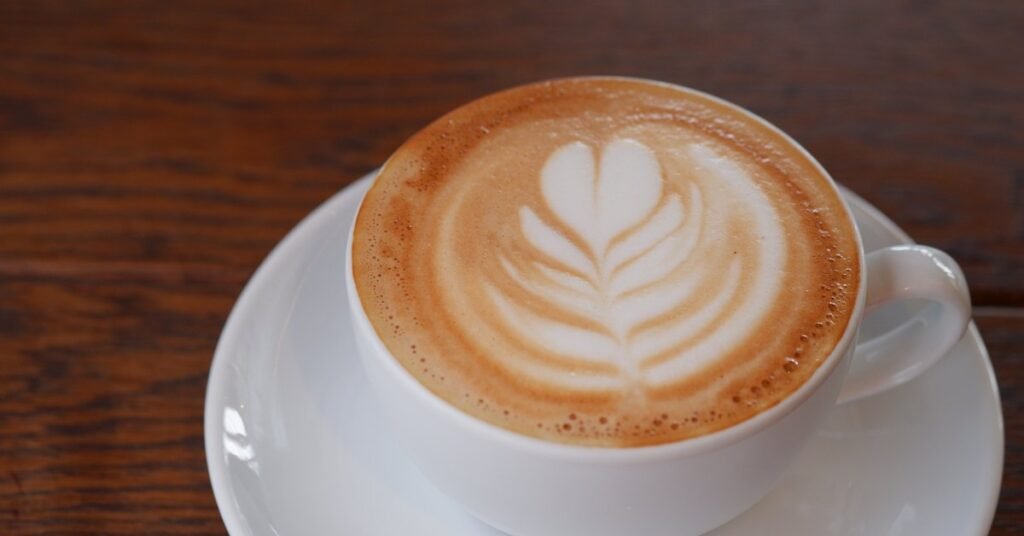
Featured image: A cappuccino with leaf latte art. Photo: Vee Satayamas, CC BY 4.0, via Wikimedia Commons (cropped).