How to make cold brew concentrate comes down to three numbers: 180 g of coarse grounds per liter of cool water (about 1:5.6 by weight), a soak of about 15 hours, and a 1:1 dilution once strained. Those are rounded middle values from 19 published recipes checked on November 10, 2026. The 16 that give their coffee by weight range from 95 to 250 g per liter, and steeps run from 8 to 24 hours.
How to make cold brew at home, step by step
This is the base recipe this guide chose from the comparison further down. It is not any one company’s recipe; each amount sits at or next to the middle of the published set.
- Weigh 180 g of whole bean coffee for every liter of water. A scale matters here: in the five recipes that put a spoon or cup measure of ground coffee next to its weight, a US cup works out to anywhere from 76 to 112 g. Without a scale, start with about 2 cups of coarse grounds per liter; the five cup weights above put 180 g between about 1 2/3 and 2 1/3 cups.
- Grind it coarse, about as coarse as for a French press. Fifteen of the 18 recipes that name a grind ask for coarse or coarser.
- Tip the grounds into a jar, pitcher or French press, add the water and stir until every clump is wet.
- Put a lid on and wait 15 hours. Ten of the 16 recipes that say where to steep keep the jar at room temperature; a steep in the fridge is the more cautious choice, and the only one Minnesota and Wisconsin allow cafes without extra approval (see the storage section).
- Lift or sieve out the spent grounds, then pass what is left through paper to catch the fine silt. Twelve of the 19 recipes name a paper filter, either as the filter or as one option.
- Bottle the concentrate in a clean, lidded jar and refrigerate.
- Serve it over ice, cut half and half with water or milk. Two parts water to one of concentrate matches the coffee-to-water ratio of hot drip coffee, though melting ice thins the glass further.
Cold brew concentrate in batch sizes
Weigh both; the cup column only helps pick a jar of the right size.
| Water | About, in US cups | Coffee | Coffee, in ounces |
|---|---|---|---|
| 250 mL | 1.06 cups | 45 g | 1.6 oz |
| 500 mL | 2.11 cups | 90 g | 3.2 oz |
| 1 L | 4.23 cups | 180 g | 6.3 oz |
| 1.9 L | 8.03 cups | 342 g | 12.1 oz |
The bottom row matches a 12 oz bag steeped in half a gallon, the batch size Toddy, Stumptown, Blue Bottle and PERC Coffee publish.
What 19 published cold brew recipes say
The comparison below covers 19 cold brew concentrate recipes from coffee companies, two brewer makers, a grocery chain and cooking outlets, each read and saved on November 10, 2026. It is a dated snapshot of the recipes that could be read that day, one per publisher, and not a survey of every recipe online. The Kitchn’s page refused automated reading and La Colombe’s served no recipe text, so neither is in it.
| Source | Amounts as published | Coffee per liter of water | Steep | Where it steeps | Water or milk per part concentrate, to start |
|---|---|---|---|---|---|
| Nguyen Coffee Supply | 112 g coffee, 5 cups water | 95 g | 12 to 18 h | Fridge | 1 |
| NYT Cooking | 35 g coffee, 1 1/2 cups water | 99 g | 12 h | Room | 1 |
| Food Network Kitchen | 1/3 cup whole beans, 1 1/2 cups water | 106 g | 12 to 24 h | Fridge | 1 |
| Whole Foods Market | 3/4 cup beans, 3 cups water | 120 g | 12 h | Room | 1 |
| The Pioneer Woman | 2 lb coffee, 8 qt water | 120 g | 12 to 24 h | Room | Not given |
| Starbucks | 22 g coffee per 180 mL water | 122 g | 12 h | Not stated | 1 |
| Counter Culture Coffee | 1 g coffee per 8 g water | 125 g | 14 h | Fridge | 0.5 to 1 |
| Serious Eats | 170 g coffee, 1,020 g water | 167 g | 8 to 12 h | Room | 2 |
| Partners Coffee | 115 g coffee, 650 g water | 177 g | 18 h | Room | 1 to 2 |
| Toddy | 340 g coffee, 1.9 L water | 179 g | 8 to 24 h | Room | 2 |
| Blue Bottle (New Orleans style) | 340 g coffee, 8 cups water | 180 g | 12 h | Room | 1.1 (milk) |
| Stumptown | 12 oz coffee, 64 oz water | 180 g | 14 to 18 h | Either | 1 |
| PERC Coffee | 12 oz coffee, 64 oz water | 180 g | 12 to 18 h | Room | Not given |
| Equal Exchange | 12 oz coffee, 7 cups water | 205 g | 12 to 24 h | Not stated | 1 |
| Driftaway Coffee | 227 g coffee, 1,000 g water | 227 g | 12 h | Not stated | 3 |
| OXO | 284 g coffee, 1,200 mL water | 237 g | 12 to 24 h | Room | 2 to 3 |
| America’s Test Kitchen | 8 oz coffee, 4 cups water | 240 g | 24 h | Room | 1 |
| Equator Coffees | 250 g coffee, 1,000 g water | 250 g | 12 h (14 h or more in the fridge) | Either | 2 to 4 |
| Lavazza USA | 1 part coffee to 6 parts water, unit not stated | Not computed | 12 to 16 h | Either | 2 |
How the table was calculated: coffee per liter is the coffee weight divided by the water volume, with 1 g of water counted as 1 mL. US units are converted with NIST Handbook 44: 1 fl oz is 29.57353 mL, a cup is 8 fl oz, a quart is 32 fl oz, an ounce of weight is 28.349523125 g and a pound is 453.59237 g. Where a recipe prints metric amounts, those are used. Two recipes give whole beans only by volume; they are converted at 113.3 g per cup, from Serious Eats’ note that 170 g of whole beans fills roughly 1 1/2 cups. That is a heavy cup by other measures: a 2023 study of six roasted Indonesian coffees found a bulk density near 0.3 g per cubic centimeter, about 71 g per cup, and Honest Coffee Guide weighed a cup of beans at about 82 g. At those weights Food Network’s recipe would be the weakest in the set, at about 67 to 77 g per liter, and Whole Foods’ glass would fall below the hot coffee band described below; the median would not change. Counter Culture’s row uses the 1:8 weight ratio it states. Medians use one time per recipe: the single time given, the middle of a range, or the minimum where only a minimum is given. The script and data file are kept with this guide’s research notes.
Ratio: a 2.6-fold spread, with a crowd in the middle
Across the 18 recipes with a usable ratio, the median is 178 g of coffee per liter, which is where the base recipe’s 180 g comes from. Among the 16 that give the coffee by weight, the strongest, Equator’s 250 g, uses 2.6 times as much coffee per liter as the weakest, Nguyen Coffee Supply’s 95 g. The recipes fall into three groups rather than one smooth range. Seven sit under 130 g per liter: three cooking outlets, Whole Foods Market, Starbucks, Nguyen and Counter Culture. Five sit between 175 and 185 g, four of them variations on that 12 oz bag in half a gallon. Five go above 200 g. Dropping the two recipes converted from whole bean volume moves the median only to 179 g, and counting Lavazza’s 1:6 as a weight ratio moves it to 177 g.
Steep time: 8 to 24 hours, though caffeine stops rising much sooner
The shortest steeps printed are 8 hours (Serious Eats and Toddy, each as the bottom of a range) and the longest 24 hours; the median of each recipe’s time is 15 hours. Seven recipes stop at 12 hours or less and America’s Test Kitchen alone steeps for a full day. A lab study that sampled caffeine through a full day of steeping at room temperature, covered below, found it had nearly stopped rising after about 400 minutes, under 7 hours; the remaining 17 hours added another 6 to 11 percent. So at room temperature the longer steeps add little caffeine, and what they change, by the recipes’ own accounts, is flavor. The study did not test the fridge, so its 400-minute mark does not carry over to a cold steep. America’s Test Kitchen is the only publisher in the set that describes testing time against taste: its 2016 version reports trying 12 to 72 hours and preferring 24.
Where it steeps
Counted by place, ten recipes are room temperature recipes, three are fridge recipes (Nguyen Coffee Supply, Counter Culture and Food Network), three leave it open and three are silent. The fridge group does not run longer: its median is 15 hours, against 15.5 for the ten room temperature recipes, though a group of three proves little. Equator alone sets a different clock for the fridge: 14 hours or more chilled, against 12 at room temperature.
Dilution: most start at 1:1, and the result varies more than the ratio suggests
Seventeen recipes give a serving ratio. Ten of them open at equal parts of concentrate and liquid. Five double the liquid, Driftaway triples it, and Blue Bottle’s New Orleans drink uses 110 g of milk per 100 g. All six concentrates under 130 g per liter that give a ratio start at 1:1. The stronger ones are split: Toddy, Equator, OXO and Serious Eats start at 1:2, while Stumptown, Partners, Equal Exchange and America’s Test Kitchen still start at 1:1.
So the drink in the glass differs more than the concentrate suggests. Divide each recipe’s coffee per liter by 1 plus its starting dilution and the 16 recipes with both figures run from 47 to 120 g of coffee per liter of total water, median 62 g. Serious Eats puts most hot coffee at 14 to 18 times as much water as coffee by weight, which is 56 to 71 g per liter. Six recipes land in that band, Serious Eats exactly on its lower edge, seven above it and three below. This arithmetic leaves out ice melt and the water the grounds keep, so read it as a comparison between recipes, not a lab measure. The base recipe here, diluted 1:1, comes to 90 g per liter, on the strong side; at 1:2 it is 60 g, inside the hot coffee band. That is a match of ratios, not of measured strength: the same Serious Eats guide says a 1:1 dilution of Stumptown’s concentrate, close to this one, leaves the drink “still slightly stronger than a cup of drip coffee,” and a 2020 lab comparison at equal ratios found less dissolved coffee in cold brews than in hot ones.
Where recipes disagree with themselves
Two pages contradict themselves, and a third recipe is converted two different ways. Starbucks’ Mason jar guide asks for 4 tablespoons (22 g) of coffee per 180 mL in its steps, but its ratio box says 20 g; at 20 g the recipe would be 111 g per liter instead of 122 g. Partners Coffee labels its recipe “Ratio: 1:15,” yet its own 115 g of coffee to 650 g of water works out to about 1:5.7. Its 35 to 40°F water temperature describes the cold water that goes in; the steep itself is at room temperature. Stumptown’s 64 ounces of water is half a gallon by its own description, about 1,893 mL, but a Serious Eats interview with Stumptown’s head brewer converts the same 64 ounces to 1,814 g, treating them as ounces of weight; the difference is about 4 percent.
Cold brew coffee maker or a jar?
A dedicated cold brew coffee maker does not set the ratio. The two brewer makers in the set print very different recipes for their own machines: Toddy’s manual puts 340 g of coffee in 1.9 L (179 g per liter) and recommends 2 parts water per part concentrate, while OXO’s guide for its brewer uses 284 g in 1,200 mL (237 g per liter) and recommends 2 to 3 parts. Blue Bottle’s guide for Hario’s cold brew bottle uses 55 g in 700 mL, about 79 g per liter, and serves the result straight over ice with no dilution; it is a ready-to-drink recipe, not a concentrate, and is left out of the medians.
What the brewers add is the filter and a tidy way to drain. Toddy’s system steeps the grounds in a paper bag over a felt disc and drains through the bottom once a stopper is pulled; OXO’s drains through a mesh filter at the flip of a switch. Without one, Starbucks and NYT Cooking reach for a Mason jar, and Stumptown and Nguyen Coffee Supply for a French press; the straining comes after. Serious Eats says plainly that no special gear is needed.
How much caffeine is in cold brew concentrate?
No study read for this guide measured caffeine in a concentrate made at 180 g per liter, and USDA’s FoodData Central has no cold brew record: searched for “cold brew” on November 10, 2026, its reference and survey data returned 96 records, and none of them was cold brew. The closest measured figures come from two studies by the same research group, both at 100 g of coffee per liter. The first is Megan Fuller and Niny Z. Rao’s study in Scientific Reports, published December 21, 2017.
Their test coffee was Kona arabica from one supplier, in two roasts and two grinds. Each brew used 35 g in 350 mL of filtered tap water, 100 g per liter, at 21 to 25°C. After 24 hours the four cold brews held 990 to 1,230 mg of caffeine per liter, about 238 to 295 mg in 240 mL. Brewed hot with the same ratio, 6 minutes at 98°C, the same coffees held 840 to 1,060 mg per liter, about 202 to 254 mg per 240 mL. In the medium grinds the cold brews also came out ahead, though not by a statistically significant margin; in the coarse grinds the gap was clear.
The second, a 2020 follow-up in Foods by Rao, Fuller and Meghan Grim, steeped a single-origin arabica from Colombia at three roast levels for 7 hours at room temperature. Its cold brews held 1,036 to 1,962 mg of caffeine per liter, about 249 to 471 mg in 240 mL, while hot French press brews of the same coffees held 1,035 to 1,095 mg. The top figure came from the darkest roast, though the paper’s text describes caffeine as comparable across roasts and brewing methods.
For scale, USDA data put an 8 fl oz cup of brewed coffee at about 95 mg (see how much caffeine is in a cup of coffee). The base recipe diluted 1:1 has 90 g of coffee per liter of total water, a little under the study’s 100 g, which points to more caffeine per ounce than that USDA cup; ice and milk change the total, and the recipe itself has not been tested.
How long cold brew concentrate keeps
The evidence here is thin. No food safety body found for this guide gives a storage time for homemade cold brew, but two US state regulators set one for cafes and shops. In Minnesota, shops must date mark cold brew for 7 days and keep it at 41°F or below from the start of brewing; the state’s Department of Agriculture classes it as a food needing time and temperature control, and lets a shop steep warmer or store longer only after a product assessment shows the process is safe. Wisconsin’s agriculture department applies the same 41°F and seven-day limits to retail cold brew made without a heat step, and says its guidance covers retail food establishments only. Between April 2018 and March 2019, the Canadian Food Inspection Agency tested 59 packaged cold brews from retailers in 11 cities. It found no Salmonella and no E. coli O157 in any of them, and no generic E. coli above its limit, yet 15 (25.4 percent) carried raised counts of general bacteria, which the agency reads as a possible sign of poor hygiene where the coffee was made. Its report, last modified in August 2020, opens by noting that food safety data on cold brew were missing. Long storage in the fridge, after a process that never heats the coffee, is why the agency rates cold brew a higher risk than hot coffee.
Two lab studies, which added very different amounts of bacteria, disagree on how long the pathogens survive. The CFIA also summarizes a 2017 challenge study from Oregon State University, in which three pathogens added to bottled cold brew neither multiplied nor lasted through three weeks, whether refrigerated or not. A 2023 study in Foods, five of whose seven authors work for Hiperbaric, a maker of high pressure processing equipment, found the same three pathogens did not grow in untreated cold brew, yet could still be detected 60 days later at 4°C. Neither study gives a home storage time. The 2023 paper does add, citing earlier work, that steeping at room temperature carries more risk of microbial growth than steeping in the fridge.
The recipes fill that gap with their own advice. Thirteen give a storage time. Twelve of them fall between 3 days (Whole Foods Market, and Lavazza at three to five days) and 2 weeks (Toddy, OXO, Partners and Serious Eats); the Pioneer Woman says hers keeps two to three weeks, at times a month. Counting her, the median is 7 days. None of them cites a test. Among the ways contamination gets in during brewing, the CFIA names contaminated water, unsanitary equipment and containers, and infected workers, so safe water, clean jars, filters and bottles, and washed hands are the precautions its report points to.
Cold brew with condensed milk, the Vietnamese way
Vietnamese iced coffee is normally brewed hot (see how to make Vietnamese iced coffee). The Pioneer Woman points this out, then makes hers cold anyway. Her glass is concentrate on ice with 2 tablespoons or more of sweetened condensed milk. She finishes it with milk or half-and-half. The coffee with condensed milk guide covers the milk itself. Nguyen Coffee Supply, which sells Vietnamese coffee blends running from 100 percent arabica to 100 percent robusta (more on those in the guide to Vietnamese coffee beans), prints the weakest concentrate among the recipes that weigh their coffee: 112 g in 5 cups of water, about 95 g per liter, steeped cold for 12 to 18 hours and cut 1:1 with milk or water.
Frequently asked questions
What is the ratio for cold brew concentrate?
The median of 18 published recipes checked on November 10, 2026 is 178 g of coffee per liter of water, a weight ratio of about 1:5.6. Among the 16 that give the coffee by weight, they range from 95 g (about 1:10.6) to 250 g (1:4). This guide’s base recipe uses 180 g per liter.
How long should cold brew concentrate steep?
The recipes checked give 8 to 24 hours, with a median of 15. In the 2017 Fuller and Rao study, steeped at room temperature, caffeine was close to its final level after about 400 minutes and rose only 6 to 11 percent more by 24 hours. Fridge steeps were not tested.
Should cold brew steep in the fridge or at room temperature?
Most use the counter: ten of the 16 that specify, against three that chill it, with steep times that barely differ. A 2023 paper on cold brew safety notes that room temperature steeping carries more risk of microbial growth than steeping in the fridge, so the fridge is the more cautious choice.
How much water do you add to cold brew concentrate?
Ten of 17 open at equal parts; five double the water. With this guide’s 180 g per liter, 1:2 matches the coffee-to-water ratio of hot drip coffee and 1:1 makes a stronger glass, though Serious Eats, writing about a similar concentrate, calls 1:1 only slightly stronger than drip. Start at 1:1 and add water to taste.
How long does cold brew concentrate last in the fridge?
No food safety body found for this guide sets a time for homemade cold brew, though Minnesota and Wisconsin hold cafes and shops to 7 days at 41°F or below. The recipes mostly say 3 days to 2 weeks, with a median of 7 days, the Pioneer Woman says up to a month, and none cites a test. In a 2023 lab study, pathogens added to untreated cold brew did not multiply, but some survived 60 days in cold storage at 4°C.
Does cold brew have more caffeine than regular coffee?
In two studies from the same lab, both at 100 g of coffee per liter, cold brew matched or beat hot: 990 to 1,230 mg per liter against 840 to 1,060 mg in 2017, and 1,036 to 1,962 mg against 1,035 to 1,095 mg in 2020. Sixteen of the 18 recipes with a ratio use more than that study’s 100 g per liter before dilution, so what lands in the glass depends mainly on how far it is cut.
Can you make cold brew concentrate without a cold brew maker?
Yes. Starbucks and NYT Cooking use a Mason jar, Stumptown and Nguyen Coffee Supply a French press; a strainer does the rest. A brewer mainly makes draining easier; it does not fix the ratio.
Sources
- Starbucks at Home, How to Make Cold Brew in a Mason Jar, accessed November 10, 2026.
- Stumptown Coffee Roasters, Homemade Cold Brew FAQs With Our Head Brewer, April 27, 2026.
- Blue Bottle Coffee, New Orleans-Style Iced Coffee Brew Guide and Hario Cold Brew Bottle Brew Guide, accessed November 10, 2026.
- Nguyen Coffee Supply, How to Make Vietnamese Cold Brew Coffee, accessed November 10, 2026.
- Toddy, Cold Brew System instruction manual, accessed November 10, 2026.
- Equator Coffees, How to Make the Perfect Cold Brew, accessed November 10, 2026.
- PERC Coffee, Cold Brew, accessed November 10, 2026.
- Partners Coffee, Brew Guide: Classic Cold Brew, accessed November 10, 2026.
- Equal Exchange, How to Brew Toddy, December 23, 2021.
- OXO, How to Use the OXO Cold Brew Coffee Maker, January 20, 2025.
- Counter Culture Coffee, Guide To Cold Brew, accessed November 10, 2026.
- Lavazza USA, How to Make Cold Brew Coffee at Home, accessed November 10, 2026.
- Driftaway Coffee, New and Refreshed Cold Brew Coffee Recipe, May 25, 2017.
- Whole Foods Market, How to Cook: Cold-Brewed Coffee, accessed November 10, 2026.
- America’s Test Kitchen, Cold Brew Concentrate, November 21, 2022.
- Serious Eats, Cold Brew Iced Coffee Recipe by Daniel Gritzer, updated March 13, 2025, and A Guide to Cold Brew Coffee by Ashley Rodriguez, updated January 13, 2025.
- NYT Cooking, Cold Brew Coffee, updated June 15, 2023.
- Food Network Kitchen, Cold Brew Iced Coffee, accessed November 10, 2026.
- Ree Drummond, The Pioneer Woman, Perfect Iced Coffee, updated April 7, 2026.
- Yusibani and colleagues, Physical and Chemical Properties of Indonesian Coffee Beans for Different Postharvest Processing Methods, Journal of Engineering and Technological Sciences, 2023.
- Honest Coffee Guide, Whole Bean to Ground Coffee Ratio, accessed November 10, 2026.
- National Institute of Standards and Technology, Handbook 44 (2026), Appendix C, General Tables of Units of Measurement.
- USDA Agricultural Research Service, FoodData Central, SR Legacy record 171890 (published April 1, 2019), and a FoodData Central search, November 10, 2026.
- Fuller and Rao, The Effect of Time, Roasting Temperature, and Grind Size on Caffeine and Chlorogenic Acid Concentrations in Cold Brew Coffee, Scientific Reports, December 21, 2017.
- Rao, Fuller and Grim, Physiochemical Characteristics of Hot and Cold Brew Coffee Chemistry: The Effects of Roast Level and Brewing Temperature on Compound Extraction, Foods, July 9, 2020.
- Minnesota Department of Agriculture, Unique Foods Processed at Retail, accessed November 10, 2026.
- Wisconsin Department of Agriculture, Trade and Consumer Protection, Wisconsin Food Code Fact Sheet: Cold Brew Coffee, P-DFRS0203 (12/23).
- Canadian Food Inspection Agency, Bacterial Pathogens in Cold Brewed Coffee, April 1, 2018 to March 31, 2019, page modified August 31, 2020.
- Polanco-Estibález and colleagues, High-Pressure Processing for Cold Brew Coffee: Safety and Quality Assessment under Refrigerated and Ambient Storage, Foods, November 23, 2023.
Part of the Vietnamese coffee guide.
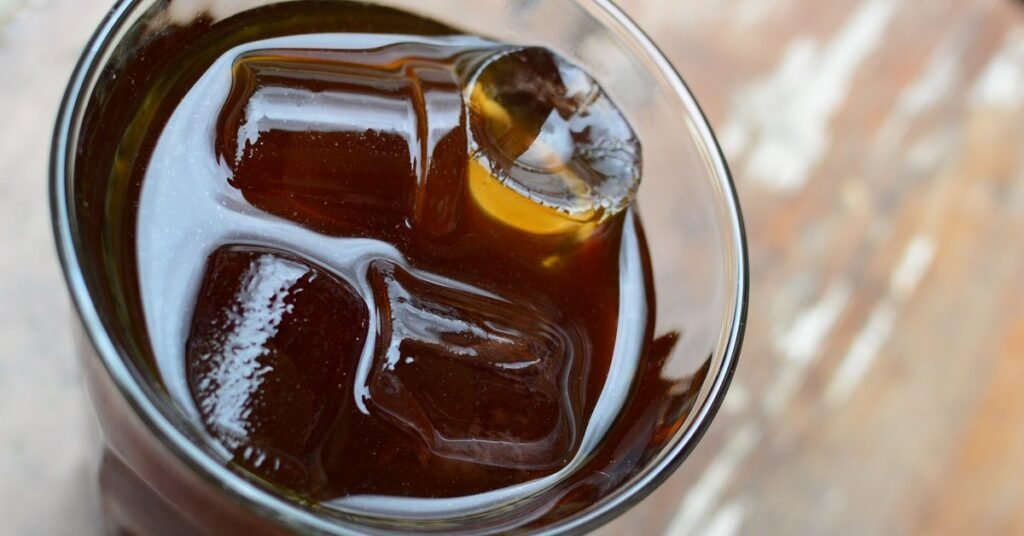
Featured image: Iced cold brew coffee. Photo: Roland Tanglao, CC0, via Wikimedia Commons (cropped).