How much caffeine is in a cup of coffee? About 95 mg in 8 fl oz of brewed coffee, going by USDA data, but it depends on whose cup it is. Of 14 coffee sellers in the US checked on November 9, 2026, the eight that publish their own figures work out to a median of about 124 mg for the same volume, with a range of 75 to 280 mg. Against the FDA’s 400 mg a day for most adults, that is about four USDA cups or three median cups, and a single Starbucks venti, listed at 390 to 490 mg, can get there alone.
Caffeine in a cup of coffee: the USDA numbers
The usual answer to how much caffeine in a cup of coffee comes from USDA FoodData Central, which reports caffeine per 100 g of drink, not the way anyone orders coffee. This table converts each record to 8 fl oz using that record’s own portion weights, and the FDC IDs let anyone pull the same data.
| Coffee (USDA record) | FDC ID, data type | Caffeine per 100 g | Grams in 8 fl oz | Caffeine per 8 fl oz | Where USDA’s value comes from |
|---|---|---|---|---|---|
| Brewed, tap water | 171890, SR Legacy | 40 mg | 237 g | 95 mg | Lab analysis, 8 data points |
| Brewed | 2710375, FNDDS | 40 mg | 240 g | 96 mg | Built on record 171890 |
| Instant, regular, prepared | 174130, SR Legacy | 26 mg | 238.4 g | 62 mg | Calculated from a recipe |
| Instant, reconstituted | 2710449, FNDDS | 26 mg | 240 g | 62 mg | Built from instant powder and water |
| Decaf, brewed | 171889, SR Legacy | 1 mg | 237 g | 2 mg | Derived from another form or a similar food |
| Decaf, instant, prepared | 171894, SR Legacy | 1 mg | 239.2 g | 2 mg | Calculated from a recipe |
| Espresso, restaurant-prepared | 171891, SR Legacy | 212 mg | 236.8 g | 502 mg (63 mg per 1 fl oz shot) | Lab analysis, 2 data points |
| Decaf espresso | 174125, SR Legacy | 1 mg | 236.8 g | 2 mg (0.3 mg per 1 fl oz shot) | Derived from another form or a similar food |
How the table was calculated: caffeine per 100 g times the grams in 8 fl oz, divided by 100. Where a record lists an 8 fl oz cup, its weight is used (237 g in SR Legacy, 240 g in FNDDS); otherwise the grams are eight times the record’s 1 fl oz weight. SR Legacy dates from April 2019 and FNDDS from October 2024. Espresso appears at 8 fl oz only to put it on the same scale.
The eight data points behind the brewed figure ran from 30 to 44 mg per 100 g, or about 71 to 104 mg per 8 fl oz. A USDA footnote says the record takes in coffee from fast food outlets as well as home brewing, and it names no brew method. “A cup” also has no fixed size. Federal nutrition labeling counts 240 mL, about 8 fl oz, while Peet’s and Death Wish quote 6 oz. On the same USDA record, 6 fl oz comes to about 71 mg and a 12 fl oz mug to about 142 mg.
How much caffeine in coffee do chains and brands publish?
Fourteen chains and brands sold in the US were checked on November 9, 2026, mostly on their own websites, for a number covering regular brewed coffee. Eight gave one. These are stated figures, not lab tests, and several come with a warning: Starbucks calls its number “an approximate value,” and Peet’s, Dunkin’ and Panera also label theirs approximate. Treat the table as a snapshot of these sellers on that date, not a survey of the US market or an average weighted by sales.
| Seller and product | Size | Caffeine, as published | Per fl oz | Cups to reach 400 mg | Figure dated |
|---|---|---|---|---|---|
| Death Wish Coffee, ground or whole bean | 6 oz | 140 to 210 mg | 23.3 to 35 mg | 1.9 to 2.9 | No date, read Nov. 9, 2026 |
| Peet’s, brewed coffee | 6 oz | About 100 to 200 mg | 16.7 to 33.3 mg | 2 to 4 | Sept. 3, 2026 |
| Starbucks, Pike Place Roast | 8 fl oz (short) | 155 to 195 mg | 19.4 to 24.4 mg | 2.1 to 2.6 | Menu data, Nov. 9, 2026 |
| Starbucks, Pike Place Roast | 12 fl oz (tall) | 235 to 290 mg | 19.6 to 24.2 mg | 1.4 to 1.7 | Menu data, Nov. 9, 2026 |
| Starbucks, Pike Place Roast | 16 fl oz (grande) | 315 to 390 mg | 19.7 to 24.4 mg | 1 to 1.3 | Menu data, Nov. 9, 2026 |
| Starbucks, Pike Place Roast | 20 fl oz (venti) | 390 to 490 mg | 19.5 to 24.5 mg | 0.8 to 1 | Menu data, Nov. 9, 2026 |
| Dunkin’, hot coffee | 10 oz (small) | About 180 mg | 18 mg | 2.2 | Sept. 22, 2020 |
| Dunkin’, hot coffee | 20 oz (large) | About 270 mg | 13.5 mg | 1.5 | Nov. 8, 2021 |
| Dunkin’, hot coffee | Extra-large, ounces not stated | About 330 mg | Not computed | 1.2 | Sept. 22, 2020 |
| Community Coffee, brewed to the bag’s ratio | 8 oz | 95 to 150 mg | 11.9 to 18.8 mg | 2.7 to 4.2 | No date, read Nov. 9, 2026 |
| Keurig K-Cup pods (Keurig Canada page) | 8 oz | 75 to 150 mg | 9.4 to 18.8 mg | 2.7 to 5.3 | No date, read Nov. 9, 2026 |
| Koffee Kult, drip coffee | 8 oz | 95 mg | 11.9 mg | 4.2 | Dec. 24, 2025 |
| Panera, Cafe Blend, dark or light roast | 16 fl oz | About 189 mg | 11.8 mg | 2.1 | Guide effective Sept. 2, 2026 |
| Panera, Cafe Blend, dark or light roast | 20 fl oz | About 237 mg | 11.9 mg | 1.7 | Guide effective Sept. 2, 2026 |
How the median was calculated: each row’s midpoint was divided by its fluid ounces, a seller’s rows were reduced to their median so that listing more sizes does not count for more, and the median was taken across the eight sellers. Cups are 400 divided by the milligrams. Dunkin’ gives its small as 10 oz on its Box O’ Joe page; the 20 oz large comes from CSPI’s caffeine chart, which also shows 270 mg, and the extra-large stays out of the per-ounce math.
The set has weak spots, and the median moves little with them, with one exception. Death Wish sells itself on strength and sets the top of the range; without it the median is about 122 mg per 8 fl oz and Peet’s sets the top at about 267 mg. The bottom, 75 mg, comes from Keurig’s Canadian page, which treats 250 mL as 8 oz, because Keurig’s US support page refused the request. Counting Caribou’s 2019 figures would give about 126 mg, as would counting Haymaker, a roaster whose own page reports an independent lab test of its dark roast at 20.4 mg per fl oz. The exception is Dunkin’: using only the 10 oz small that Dunkin’ itself sizes, and not CSPI’s 20 oz, lifts the median to about 133 mg.
The sellers’ median comes to about 15.5 mg per fl oz, which is about 124 mg per 8 fl oz, 186 mg per 12 fl oz and 1.3 times USDA’s 11.84 mg per fl oz. Panera and Koffee Kult land almost exactly on USDA’s rate, and neither says how its number was produced; Koffee Kult’s decaf and espresso figures, 2 mg per 8 oz and 64 mg per 1 oz shot, also sit at or near USDA’s values. At their midpoints, Starbucks, Peet’s and Death Wish work out to about 1.9, 2.1 and 2.5 times USDA, above the 9.4 to 20.6 mg per fl oz implied by the FDA’s typical 113 to 247 mg for 12 fl oz of regular, non-specialty brewed coffee.
The other six sellers gave no usable number on the pages read:
| Seller | Pages read | What they showed |
|---|---|---|
| McDonald’s | Premium Roast small and large product pages, US FAQ | Calories and nutrients, no mention of caffeine |
| Folgers | Classic Roast product page and its questions section | Says the coffee is caffeinated, with no amount. CSPI’s chart lists 120 to 160 mg for 2 tablespoons making 12 oz |
| Maxwell House | Original Roast page on the Kraft Heinz site | No mention of caffeine |
| Tim Hortons | US FAQ, Canadian nutrition guide of August 2025, Canadian help page | No figure; the help page says to contact staff instead. A December 2015 US guide on a third-party site listed 140 mg for 10 oz |
| Caribou Coffee | Nutrition page (returned a 404), Caribou Blend product page | No current figure. An archived Caribou PDF of January 2019 listed 230, 305 and 385 mg for 12, 16 and 20 fl oz, and CSPI’s chart still shows the 305 mg |
| Black Rifle Coffee | FAQ page | No caffeine figure for brewed coffee; its ready-to-drink cans carry caffeine totals in their product names |
CSPI’s chart, last updated in March and April 2025, the 2015 guide and the 2019 PDF are not counted in the median. Dunkin’s current nutrition guide, updated October 28, 2026, has no caffeine column either, so its row rests on newsroom posts still online on the check date.
Why the same cup can differ
How much coffee goes in
Across lab studies, more coffee per liter generally means more caffeine, though not neatly. Below are six published results picked from a longer list, from Swiss lab work, a 2024 paper on roast and a 2021 literature review:
| Study and method | Coffee per liter | Caffeine per 8 fl oz (240 mL) |
|---|---|---|
| Gloess 2013, paper filter machine | 56 g | 112 mg |
| Gloess 2013, Karlsbad pot | 55 g | 114 mg |
| Gloess 2013, French press | 55 g | 124 mg |
| Angeloni 2018, French press | 60 g | 125 mg |
| Lindsey 2024, AeroPress, two Ethiopian coffees, 1 to 10 minute steeps | 67 g | 134 to 165 mg |
| Rao 2020, French press | 100 g | 248 to 263 mg |
How the table was calculated: the Swiss study reports caffeine per 120 mL cup, doubled here. The two review figures, given in grams per liter, are multiplied by 0.24. The 2024 study states its own per 8 oz range. The dose column divides grams of coffee by whichever volume a paper states, water or finished brew. Beans and labs differ, so read this as a pattern, not a formula.
Across these papers, going from about 55 g to 100 g per liter went with roughly double the caffeine. That is a pattern pieced together from different labs and beans, not one experiment: the review that reports both French press results puts their twofold gap down to several possible causes, the amount of coffee among them, and its own table lists a filter machine brew at about 83 g per liter with about 334 mg per 8 fl oz, more than the 100 g rows. Swapping the method at a similar dose moved it far less: using a single Guatemalan coffee, the Swiss team got 56 mg per 120 mL from a paper filter and 62 mg from a French press. Starbucks gives its brewed ratio as between 1:15 and 1:18, which spans the first five rows, yet its listed 155 to 195 mg per 8 fl oz starts near their top and runs past it. Ratio alone does not explain that gap.
The same drink on different days
For a 2003 paper in the Journal of Analytical Toxicology, a University of Florida team ran gas chromatography on drinks collected at cafés. Brewed versions averaged 188 mg in 16 oz, about 11.8 mg per fl oz and close to USDA’s rate. Yet one drink collected at one outlet on six days in a row measured 259 to 564 mg per dose, more than double from lowest to highest. No published figure, including the ones above, can promise what a given cup holds.
Robusta and arabica
A 2021 review in Foods found robusta brews usually hold between 1.4 and 1.8 times arabica’s caffeine, with a few exceptions such as one coffee-machine test where arabica came out ahead. The gap matters for Vietnamese coffee, because Vietnam’s crop leans heavily on robusta (see the guide to Vietnamese coffee beans). The page on why Vietnamese coffee is so strong estimates between 100 and 220 mg for a pure robusta phin. The Vietnamese coffee guide covers the drinks themselves.
Light roast vs dark roast
The best-controlled data read for this guide show only a small gap, and its direction depends on how brews are compared. A 2024 Scientific Reports paper tested 90 brews from two Ethiopian coffees. Matched on extraction yield, the darker batches usually held more caffeine, but darker coffee gave up less of its soluble material, so brewed the same way as the lighter batches they usually ended with less. In the 10-minute brews, caffeine peaked in the light to medium batches. Across all roasts and steep times of 1, 2 and 10 minutes, an 8 oz cup held 134 to 165 mg for one coffee and 145 to 165 mg for the other, with the lowest figure from a 1-minute steep. In the 10-minute brews alone, the paper’s charts show roast moving the cup by roughly 4 mg for one coffee and 13 mg for the other. The 2021 review reports a split: some studies saw no clear effect of roast, others saw caffeine drop as roasting went further, including a 2011 Food Chemistry comparison of four coffees.
Sellers mostly do not separate roasts. Panera lists 189 mg for dark and light alike at 16 fl oz, and Starbucks’ menu shows identical ranges at every size for its current blonde, medium and dark hot coffees. Keurig Canada’s FAQ gives it as a general rule that darker roasts hold less caffeine. Death Wish goes the other way, listing its dark roast at 180 mg and its light at 155 mg, though those are different products.
How many cups of coffee reach 400 mg?
The FDA puts the figure for most adults at 400 mg a day, or roughly two to three 12 fl oz cups by its count, and describes that as “an amount not generally associated with negative effects.” The European Food Safety Authority (EFSA) also lands on 400 mg, writing that intakes up to that level, spread through the day, “do not raise safety concerns for healthy adults in the general population, except pregnant women.” For a single dose, its figure for healthy adults is 200 mg, which a Starbucks tall or Panera’s 20 fl oz cup passes on its listed numbers, and it notes that 100 mg may affect sleep in some adults when taken close to bedtime. How fast the body clears caffeine differs widely from person to person, the FDA adds, as does how strongly it is felt, and body weight, medications and some medical conditions change how much is too much. Its 400 mg is an adult figure: for children and teens it points parents to a health care professional, and it repeats federal advice that children under 2 should not have caffeinated drinks. The cup counts below are arithmetic against the adult figure, not a safe number of cups for any one person.
| Cup | Caffeine | Cups to reach 400 mg |
|---|---|---|
| USDA brewed, 8 fl oz | 95 mg | 4.2 |
| Seller median, 8 fl oz | 124 mg | 3.2 |
| USDA brewed, 12 fl oz | 142 mg | 2.8 |
| Seller median, 12 fl oz | 186 mg | 2.1 |
| FDA typical range, 12 fl oz | 113 to 247 mg | 1.6 to 3.5 |
| Caffeinated soda, 12 fl oz (FDA chart, for comparison) | 23 to 83 mg | 4.8 to 17.4 |
| Energy drink, 12 fl oz (FDA chart, for comparison) | 41 to 246 mg | 1.6 to 9.8 |
In pregnancy, while breastfeeding or when trying to conceive, the FDA’s advice is to ask a health care provider about cutting back. The American College of Obstetricians and Gynecologists says intake under 200 mg a day “does not appear to be a major contributing factor in miscarriage or preterm birth.” It treats the question of growth restriction as still open, and says no final conclusion is possible yet on whether high intake is linked to miscarriage. EFSA, for its part, says up to 200 mg a day from all sources, spread through the day, raises no safety concerns for the fetus.
Frequently asked questions
How many mg of caffeine are in a cup of coffee?
About 95 mg in 8 fl oz of brewed coffee on USDA data, or 0.095 g, and about 142 mg in 12 fl oz. The FDA’s typical range for 12 fl oz is 113 to 247 mg. Sellers’ own figures, checked in November 2026, run higher, with a median of about 124 mg per 8 fl oz.
How much caffeine is in a shot of espresso?
USDA data work out to about 63 mg in a 1 fl oz shot. Peet’s gives about 70 mg per shot and Starbucks about 75 mg. For doubles and café lab results, see caffeine in espresso vs coffee.
How much caffeine is in decaf coffee?
USDA’s record works out to about 2 mg per 8 fl oz, a derived value rather than a measured one, and the FDA’s typical range for decaf is 2 to 15 mg in that volume. Sellers differ: Keurig says 2 to 4 mg for 8 oz, Panera about 5 mg for 16 fl oz, Peet’s about 4 to 8 mg for 6 oz, and Starbucks 15 mg for a short and 25 mg for a grande. In a 2006 University of Florida test, decaf from 10 different outlets held 0 to 13.9 mg per 16 oz.
How many cups of coffee is 400 mg of caffeine?
About four 8 fl oz cups at USDA’s figure, about three at the sellers’ median, and two to three 12 fl oz cups by the FDA’s count. At Starbucks it takes far fewer: one grande is listed at 315 to 390 mg. These counts are arithmetic for most healthy adults, not a safe dose for everyone: the FDA notes wide differences between people, asks anyone pregnant, breastfeeding, or worried about a medical condition or a medicine to talk to a health care provider, and gives its 400 mg as an adult figure.
How much caffeine is in instant coffee?
About 62 mg per 8 fl oz in USDA data, roughly two-thirds of its brewed figure, and about 47 mg in the 6 fl oz serving the record lists. USDA calculated that value from a recipe and did not measure it.
Does dark roast have more caffeine than light roast?
Not reliably. A 2024 study had it both ways: dark batches fell short under one recipe yet led once extraction yield was matched, and in its 10-minute brews roast moved an 8 oz cup by only about 4 to 13 mg, read from the paper’s charts. Panera and Starbucks list the same caffeine for their dark and light roasts.
How much caffeine is in a 12 oz cup of coffee?
About 142 mg at USDA’s rate and about 186 mg at the sellers’ median, with the FDA’s typical range at 113 to 247 mg. Starbucks lists 235 to 290 mg for a 12 fl oz tall, and an April 2026 Starbucks article gives about 260 mg.
Sources
- USDA Agricultural Research Service, FoodData Central: SR Legacy records 171890, 174130, 171889, 171894, 171891 and 174125 (published April 1, 2019) and FNDDS records 2710375 and 2710449 (published October 31, 2024), accessed November 9, 2026.
- US Food and Drug Administration, Spilling the Beans: How Much Caffeine is Too Much?, content current as of August 28, 2024.
- European Food Safety Authority, Caffeine (topic page), accessed November 9, 2026.
- American College of Obstetricians and Gynecologists, Committee Opinion No. 462, Moderate Caffeine Consumption During Pregnancy, August 2010, reaffirmed 2026.
- Code of Federal Regulations, 21 CFR 101.9, Nutrition labeling of food, current text accessed November 3, 2026.
- Starbucks, menu and nutrition data for Pike Place Roast, Starbucks Christmas Blonde, Thanksgiving Blend and Decaf Pike Place Roast, accessed November 9, 2026.
- Starbucks, Coffee Science: Which Starbucks drink has the most caffeine, April 30, 2026.
- Peet’s Coffee, Caffeine Content, updated September 3, 2026.
- Death Wish Coffee, How Strong is Death Wish Coffee? (caffeine page), accessed November 9, 2026.
- Dunkin’, Dunkin’ Answers Your Top Coffee Questions, September 22, 2020.
- Dunkin’, Dunkin’ Answers Your Top Cappuccino Questions, November 8, 2021.
- Dunkin’, Box O’ Joe Coffee page, and Nutrition Guide last updated October 28, 2026, accessed November 9, 2026.
- Community Coffee, FAQ, accessed November 9, 2026.
- Keurig Canada, K-Cup Pods FAQs and Support, accessed November 9, 2026.
- Koffee Kult, Caffeine Content, modified December 24, 2025.
- Panera Bread, Nutrition Guide, effective September 2, 2026.
- McDonald’s, Premium Roast Coffee small and large pages and FAQ, accessed November 9, 2026.
- Folgers, Classic Roast Coffee page, accessed November 9, 2026.
- Maxwell House (Kraft Heinz), Original Roast Ground Coffee page, accessed November 9, 2026.
- Tim Hortons, US FAQ and Canadian help page (updated April 23, 2025), Canadian nutrition guide of August 2025, and US nutrition guide of December 2015, accessed November 9, 2026.
- Caribou Coffee, Caribou Blend page and nutrition address, accessed November 9, 2026, and Nutrition and Allergen Information, last item update January 3, 2019, Internet Archive copy of September 21, 2019.
- Black Rifle Coffee Company, FAQ, accessed November 9, 2026.
- Center for Science in the Public Interest, Caffeine chart, last updated March to April 2025.
- McCusker, Goldberger and Cone, Caffeine content of specialty coffees, Journal of Analytical Toxicology, October 2003.
- McCusker and colleagues, Caffeine content of decaffeinated coffee, Journal of Analytical Toxicology, October 2006.
- Gloess and colleagues, Comparison of nine common coffee extraction methods: instrumental and sensory analysis, European Food Research and Technology, January 30, 2013.
- Olechno and colleagues, Influence of Various Factors on Caffeine Content in Coffee Brews, Foods, 2021 (also the source here for the Rao 2020 and Angeloni 2018 figures).
- Lindsey and colleagues, Caffeine content in filter coffee brews as a function of degree of roast and extraction yield, Scientific Reports, November 25, 2024.
- Hečimović and colleagues, Comparative study of polyphenols and caffeine in different coffee varieties affected by the degree of roasting, Food Chemistry, December 2011.
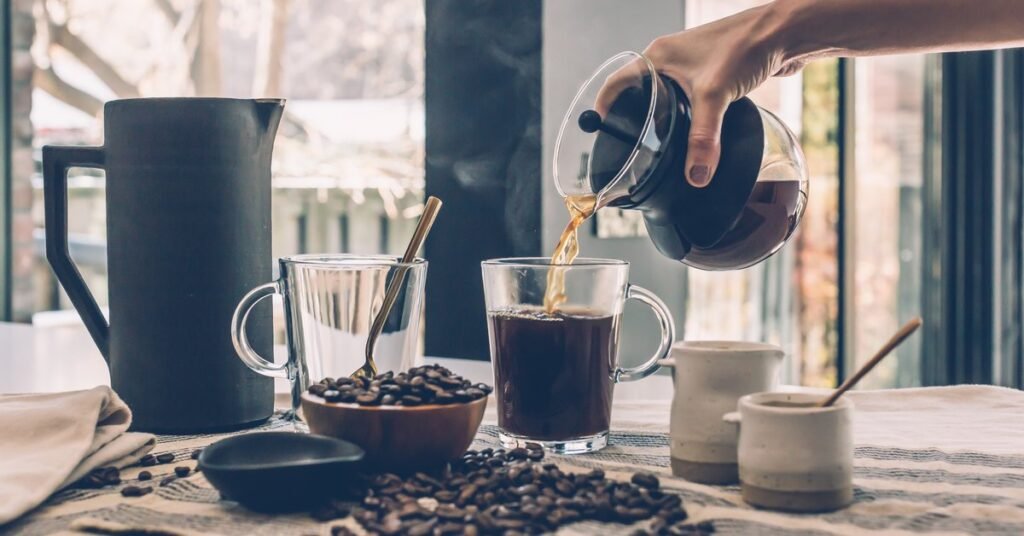
Featured image: Brewed coffee poured from a glass carafe. Photo: Matthew Henry, CC0, via Wikimedia Commons (cropped).