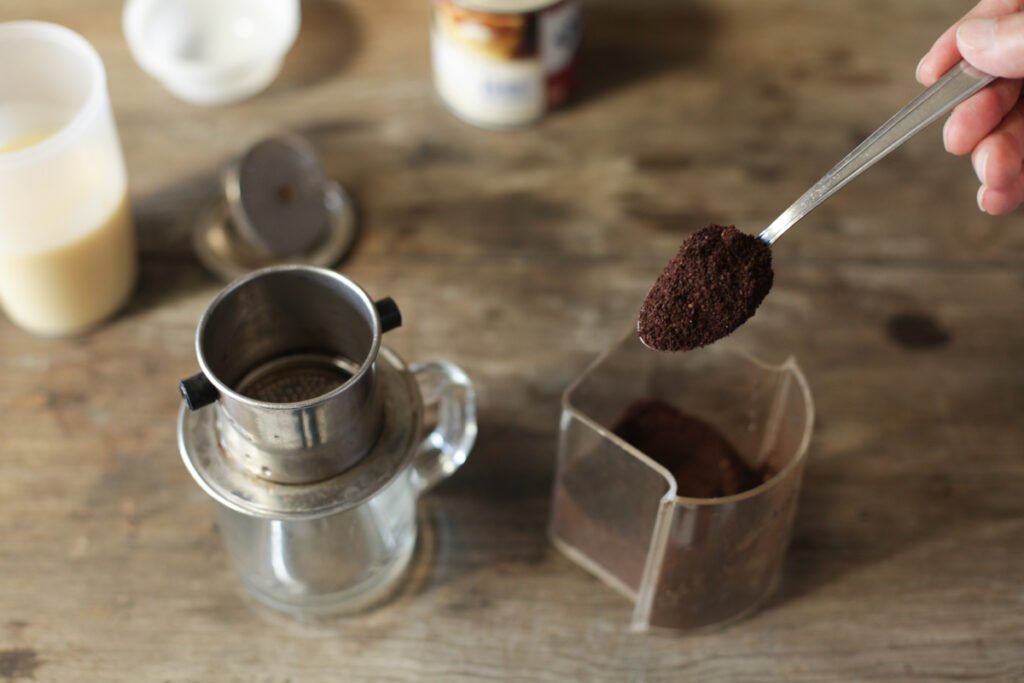
To use a phin filter, set the filter plate and brew chamber on a cup, add about 14 g (2 tablespoons) of medium-fine ground coffee, and rest the press on top. Pour 20 to 30 ml of water at 195 to 205°F (about 91 to 96°C) to bloom the grounds for 30 to 45 seconds, then fill the chamber, cover it, and let it drip for 4 to 5 minutes. If the drip runs much faster or slower than that, adjust the grind size or the press.
What a phin filter is
A phin, called cà phê phin in Vietnam, is a small metal drip brewer and the most widely used way to make coffee there. With no paper filter, the coffee’s oils stay in the cup and add body, giving a small, concentrated serving closer to espresso than to drip coffee.
The origin of this Vietnamese coffee filter is not settled. Coffee arrived with the French in the mid-19th century, and writers have proposed several ancestors for the phin, from French drip pots to the Madras filter of colonial India.
The parts of a phin
- Filter plate: a perforated disc with a wide rim that rests on the cup.
- Brew chamber: the cylinder that holds the coffee and water, with a perforated base. On some models it is joined to the plate, leaving three parts instead of four.
- Press: a perforated insert, also called a gravity press or dispersion screen, that sits on the grounds and keeps the coffee bed in place as water is poured.
- Lid: holds in heat during the brew, then doubles as a tray for the phin afterward.
Gravity press vs screw-down press
- Gravity press: rests on the coffee under its own weight, with nothing to set. It lets gas escape as fresh coffee blooms, and Nguyen Coffee Supply prefers it for freshly roasted beans. Flow is adjusted mainly through grind size.
- Screw-down press: threads onto the chamber, so you can set how firmly it holds the coffee bed. That gives direct control over drip speed and suits pre-ground coffee, but overtightening slows the drip to a near stop, and very fresh coffee has less room to expand.
How far to loosen a screw-down press varies by guide. CoffeeGeek tightens until it feels the resistance of the grounds, then backs off one full turn; other guides loosen it only slightly.
Sizes and materials
The single-serve phin is the most common size and holds about 120 ml (4 oz) of water. Ounce labels are inconsistent: Nguyen Coffee Supply sells its single-serve model as a 4 oz phin, while CoffeeGeek describes the common 120 ml size as a 6 or 8 oz phin, so compare capacity in milliliters. Larger phins, up to family-size models holding around 40 oz (1.2 liters), need proportionally more coffee.
Most phins are made of stainless steel or aluminum. Stainless steel is heavier, and some sources say it holds heat better; Nguyen Coffee Supply rates its stainless phins dishwasher safe. Aluminum has about a third of the density of steel, so it is light to carry, but it should be washed by hand because dishwasher detergents can darken it.
How to use a phin filter for a hot cup
- Coffee: 14 g (about 2 tablespoons), the dose Nguyen Coffee Supply and Copper Cow Coffee use. CoffeeGeek prefers less for hot coffee, about 8 to 10 g per 100 ml (roughly 10 to 12 g here), since no ice will dilute it.
- Water: about 120 ml (4 oz) in total, including the bloom
- Water temperature: 195 to 205°F (about 91 to 96°C), just off the boil
- Grind: medium-fine, between pour-over and espresso
- Load the coffee. Set the filter plate and chamber on your cup, add the grounds, and gently shake or tap the phin until the bed is level. An uneven bed sends water down one side and extracts unevenly.
- Add the press. Rest a gravity press on the grounds without pushing down hard, or screw a screw-down press to light resistance and loosen it.
- Bloom. Pour 20 to 30 ml of water, enough to cover the press by about 1.3 cm (half an inch), and wait 30 to 45 seconds. Guides range from 20 seconds to a full minute. Fresh coffee releases carbon dioxide and swells, which prepares the bed for even extraction.
- Fill and cover. Slowly pour the remaining water to the top of the chamber and put the lid on.
- Wait. The first drops should fall within about 2 minutes, and the brew should finish in roughly 4 to 5 minutes. A lighter dose finishes in around 3 to 4 minutes.
- Serve. When dripping stops, set the phin on its upturned lid. Drink the coffee black, or stir in sweetened condensed milk for cà phê sữa nóng; CoffeeGeek suggests starting with 15 to 20 ml.
To keep the cup warm during the drip, the traditional approach in Vietnam is to stand the glass in a shallow bowl of near-boiling water. The cold version is brewed stronger to allow for melting ice; for that, follow the Vietnamese iced coffee recipe.
Choosing the grind and the coffee
Grind size is the main variable, and with no paper to catch fine particles it needs to be right from the start. Most guides land between espresso and pour-over: Nguyen Coffee Supply compares the ideal to a moka pot grind, while CoffeeGeek goes halfway between moka pot and pour-over, with a texture like table salt. Too coarse and the water runs straight through, leaving a weak cup. Too fine and the drip stalls, and the coffee can taste burnt or harsh.
Pre-ground coffee works too. Copper Cow Coffee says a medium or universal grind is fine, and Nguyen Coffee Supply says a screw-down press generally works best with pre-ground coffee.
Traditional Vietnamese coffee uses dark-roasted robusta. Vietnam grows mostly robusta, which brews with roughly 1.4 to 1.8 times the caffeine of arabica and has a more bitter flavor that stands up to condensed milk (more on why Vietnamese coffee is so strong). A medium-roast arabica or a robusta and arabica blend gives a sweeter, more nuanced cup.
How to adjust drip speed
If it drips too fast
- Grind finer, one step at a time.
- On a screw-down phin, tighten the press slightly.
- Expect stale coffee to run faster, since it hardly blooms.
If it drips too slowly or stops
- Lift the press for a second or two with a chopstick or spoon handle, then let it drop back. Very fresh coffee can release enough gas to create suction and stall the flow.
- Loosen a screw-down press, or grind coarser next time. Water still pooled in the chamber after 5 minutes means the grind is too fine or the press too tight.
- Start with a completely dry phin and clear holes, since leftover water in the holes can block the flow.
- If the lid fits tightly, set it slightly off-center. Coava Coffee Roasters notes that a sealed lid can create a vacuum that stops the drip.
Cleaning and care
- Empty the grounds and rinse each piece. Water and a little dish soap are enough for daily cleaning.
- Use the soft side of a sponge or a cloth. Abrasive scrubbers and steel wool speed up wear on the thin metal.
- Check the maker’s guidance before using a dishwasher. Nguyen Coffee Supply says its phins are dishwasher safe but still recommends hand washing. Always hand wash aluminum; if it darkens, lemon juice, vinegar or cream of tartar can remove the discoloration.
- Dry every piece completely and check that no holes are blocked.
Common mistakes
- Overtightening a screw-down press. The drip slows to a crawl.
- Overfilling the chamber. Grounds need room to swell. The 120 ml phin in CoffeeGeek’s guide holds a maximum of 15 g of coffee.
- Leaving the lid off. The brew loses heat over several minutes, which flattens the extraction.
How to choose a good phin
The best phin filter is the one that suits your cup, your coffee and the way you brew.
- Capacity: about 120 ml (4 oz) for a single cup.
- Press type: gravity if you grind fresh beans or want the simplest routine, screw-down if you mostly use pre-ground coffee and want to fine-tune the drip.
- Material: stainless steel if you want a heavier phin that may be dishwasher safe, aluminum if low weight matters most and hand washing is fine.
- Fit: the filter plate should sit flat and steady on the rim of the cup you use most.
- A complete set: Andrea Nguyen of Viet World Kitchen advises choosing an unopened package, since store packages are often opened, and checking that every part is there and works.
- Price: phins are inexpensive. CoffeeGeek lists typical prices of $5 to $20.
Frequently asked questions
How long should a phin filter take to drip?
About 4 to 5 minutes for a single-serve phin, with the first drops falling within about 2 minutes. Guides range from 3 to 6 minutes overall.
What grind size is best for a phin filter?
Medium-fine: finer than pour-over and coarser than espresso, from about a moka pot setting to halfway toward pour-over, with a texture like table salt or sand.
How much coffee do you put in a phin filter?
Most guides use about 14 g, or 2 tablespoons, for 120 ml (4 oz) of water. CoffeeGeek suggests a lighter 8 to 10 g per 100 ml for hot coffee served without ice.
Can you use regular ground coffee in a phin?
Yes. A medium or universal supermarket grind generally works, especially with a screw-down press, though it will barely bloom and may drip faster.
Is a stainless steel or aluminum phin better?
Both use the same brewing method. Stainless steel is heavier, may be dishwasher safe depending on the maker, and some sources say it holds heat better. Aluminum is much lighter but should be washed by hand.