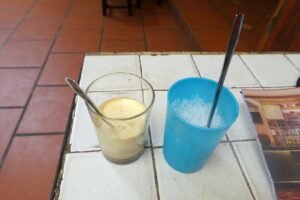
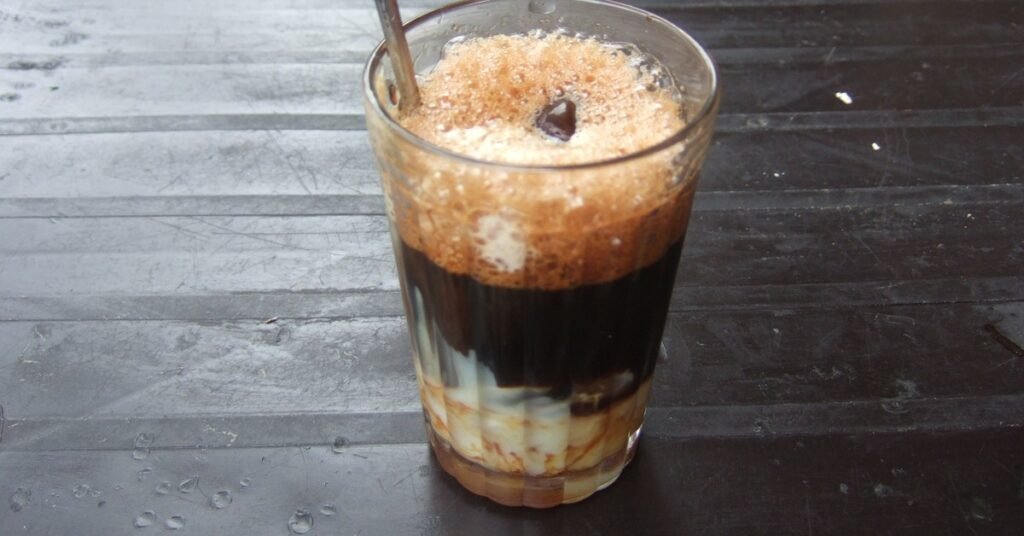
Coffee with condensed milk is strong coffee mixed with sweetened condensed milk, which whitens and sweetens the cup in one go. The published recipes compared below use 2 teaspoons to 3 tablespoons per drink, most often 1 or 2 tablespoons, and each tablespoon adds a thick, creamy body that takes the edge off bitterness, along with about 10 grams of sugar. The pairing became everyday coffee in Vietnam and Singapore, where canned milk was cheaper, safer or easier to keep than fresh milk, and Spain has its own version, the café bombón.
Can you use sweetened condensed milk in coffee?
Yes. Eagle Brand’s FAQ says it needs no preparation, and coffee is the first use it suggests. Because it is milk and sugar in one, most recipes add no other sweetener.
Two habits make coffee and sweetened condensed milk work together. First, brew the coffee stronger than usual. Nguyen Coffee Supply calls this the important part: the drink depends on strong coffee to offset the sweetness. Second, mix it in: CoffeeGeek warns that the heavy milk settles under the coffee and will not blend by itself, and most iced recipes, from Allrecipes to Hot Thai Kitchen, dissolve it in hot coffee before adding ice. Condensed milk also tempers the coffee’s bitterness, as Saveur’s recipe puts it, which is why a very strong Vietnamese coffee can taste mild.
What sweetened condensed milk is, and how it differs from evaporated milk
Gail Borden was granted patents in both the United States and Britain in 1856 for condensing milk in a vacuum, according to the Handbook of Texas. Both canned milks now have US federal standards of identity:
- Sweetened condensed milk (21 CFR 131.120): milk and a sugar-type sweetener, concentrated by taking out some of the water. By weight it has to be at least 8 percent milkfat and 28 percent total milk solids, it is pasteurized, and there must be enough sweetener to stop it spoiling. The sugar, in other words, is the preservative.
- Evaporated milk (21 CFR 131.130): plain milk concentrated the same way, unsweetened unless flavored. Its floor is 6.5 percent milkfat and 23 percent total milk solids; vitamin D is mandatory, and the milk is homogenized, heat-treated and sealed in a container so it keeps.
Eagle Brand’s ingredient list in FoodData Central is just milk and sugar. The company says about 60 percent of the water is removed from its condensed milk and about 50 percent from its evaporated milk, and advises against substituting evaporated milk in recipes, since it has no sugar.
Condensed milk vs creamer, half-and-half and sugar, per tablespoon
Figures are calculated from USDA FoodData Central (FDC) SR Legacy values per 100 grams and each record’s own portion weights, converting fluid ounces and teaspoons on the FDA labeling basis (1 fluid ounce is 2 tablespoons; 1 tablespoon is 3 teaspoons).
| Per tablespoon | FDC ID | Grams | Calories | Sugars (g) | Fat (g) | Saturated fat (g) |
|---|---|---|---|---|---|---|
| Sweetened condensed milk | 171275 | 19.1 | 61 | 10.4 | 1.7 | 1.0 |
| Evaporated milk | 171276 | 15.75 | 21 | 1.6 | 1.2 | 0.7 |
| Whole milk | 171265 | 15 | 9 | 0.8 | 0.5 | 0.3 |
| Half-and-half | 171255 | 15 | 20 | 0.6 | 1.7 | 1.1 |
| Liquid creamer, plain | 171261 | 15 | 20 | 1.7 | 1.5 | 0.3 |
| Liquid creamer, flavored | 173453 | 15 | 38 | 5.0 | 2.0 | 0.4 |
| Powdered creamer | 171263 | 6 | 32 | 0.5 | 2.0 | 1.1 |
| Granulated sugar | 169655 | 12.6 | 49 | 12.6 | 0 | 0 |
Spoon for spoon, condensed milk has about three times the calories of half-and-half and about four-fifths as much sugar as granulated sugar. Two tablespoons, as used in the Allrecipes and CoffeeGeek iced recipes, add about 123 calories and 21 grams of sugar. Most of that is added sugar. FDC’s newer Foundation analysis (FDC 2758990, published in 2026) splits it about 83 percent sucrose to 17 percent lactose, and plain milk contains lactose but no sucrose, so the sucrose is the added sugar.
How much condensed milk to put in coffee: a ratio guide
No single ratio is standard; these are the amounts published recipes give.
| Coffee | Condensed milk | Source |
|---|---|---|
| Phin, hot | 15 to 20 ml (1 to 1 1/3 tablespoons), with 8 to 10 g of coffee per 100 ml of water | CoffeeGeek |
| Phin or other strong brew | 1 to 3 tablespoons per 14 g of coffee and 4 oz of water; 2 to 3 if iced | Nguyen Coffee Supply |
| Phin, iced | 1 tablespoon (18 g) per 10 g of coffee and 84 g of water | Saveur |
| Phin, iced | 2 tablespoons (30 ml) per 14 g of coffee and 120 ml of water | CoffeeGeek |
| Brewed coffee, iced | 2 tablespoons per cup of brewed coffee | Allrecipes |
| Iced coffee or cold brew | 1 to 2 tablespoons, added gradually | Food Republic |
| Espresso (café bombón) | Equal parts, or 2 parts coffee to 1 part milk | Food Republic; Directo al Paladar |
| Instant coffee | 2 teaspoons per 120 ml, up to 3 tablespoons per cup of water | Nescafé |
| Thai iced coffee | 2 tablespoons, plus 2 teaspoons of sugar, per 160 ml of coffee | Hot Thai Kitchen |
In the three recipes that give separate hot and iced amounts, the iced amount starts higher. Start with a tablespoon and work up a teaspoon at a time; as CoffeeGeek points out, an extra spoonful cannot be removed once it is in.
How to make coffee with condensed milk
Both versions use the published amounts above; for the full Vietnamese method, see how to make Vietnamese iced coffee.
Hot coffee with condensed milk
- 1 tablespoon (15 ml) sweetened condensed milk, or up to 2 to taste
- Coffee for a phin: 10 to 12 g (about 1 1/2 tablespoons), ground medium-fine, plus 120 ml (4 oz) of water just off the boil
- Or about 120 ml (4 oz) of strong coffee from a French press or a pour-over
- Add the milk first. Spoon the condensed milk into a heatproof glass or cup.
- Brew straight onto it. With less coffee in the chamber, the drip should finish in 3 to 4 minutes. New to the filter? See how to use a phin filter.
- Keep it hot. Stand the glass, phin and all, in a shallow bowl of very hot water until the drip finishes; CoffeeGeek describes this as the traditional Vietnamese way to keep the hot version warm.
- Stir well. Scrape the bottom for 20 to 30 seconds until the color is even.
- Adjust. Taste, then add condensed milk a teaspoon at a time.
Iced coffee with condensed milk
- 1 to 2 tablespoons sweetened condensed milk
- Coffee: 14 g (about 2 tablespoons) for a phin with 120 ml (4 oz) of just-boiled water, or about 120 ml of very strong French press or pour-over coffee
- A tall glass filled with ice
- Add the milk first. Put the condensed milk in a heatproof glass.
- Brew onto the milk. The 14 g dose is already stronger than the hot version, which allows for the melting ice.
- Stir until smooth. Mix until no streaks of milk are left at the bottom.
- Pour over ice. Tip it into the glass of ice and stir again. With ordinary brewed coffee, Allrecipes stirs 2 tablespoons into each cup while hot, then pours it over ice.
Condensed milk coffee around the world
| Place | Drink | What goes in, and how it is served | Source |
|---|---|---|---|
| Vietnam | Cà phê sữa đá | Crushed ice, condensed milk and robusta dripped through a phin | Viet Nam National Authority of Tourism |
| Vietnam | Cà phê sữa nóng | Served hot instead of iced, the cup often set in a dish of hot water | CoffeeGeek; Nguyen Coffee Supply |
| Vietnam (Saigon) | Bạc xỉu | Mostly milk with a little coffee; Saveur says early versions got their milkiness from condensed milk and hot water, and fresh milk is a common addition today | Saveur; Viet Nam National Authority of Tourism |
| Vietnam (Hanoi) | Cà phê trứng | Egg coffee: a foam of egg yolk beaten with condensed milk, often with sugar, floated on phin coffee | CoffeeGeek |
| Spain (Valencia region) | Café bombón | Served in a small glass, the condensed milk forming a pale band beneath the espresso | Visit València; Food Republic; Directo al Paladar |
| Spain (Cartagena) | Café asiático | Espresso with brandy, Licor 43 and condensed milk | Directo al Paladar |
| Spain (Canary Islands) | Barraquito; leche y leche | Barraquito: espresso, condensed milk and a shot of liqueur, with cinnamon and lemon; Directo al Paladar describes three layers, the liqueur in the middle. Leche y leche (La Palma): coffee with ordinary and condensed milk | spain.info; Directo al Paladar |
| Singapore | Kopi | Brewed through a muslin bag, sweetened with condensed milk and sugar; order kopi c to get evaporated milk | National Library Board; Singapore Chinese Cultural Centre |
| Malaysia (Ipoh) | Ipoh white coffee | Margarine-roasted coffee served with condensed milk; Going Places credits the milk, which lightens the cup, for the name “white coffee” | Going Places (Malaysia Airlines) |
| Thailand | Gafae yen | Very dark Thai coffee with sugar and sweetened condensed milk, poured over ice and topped with a little evaporated milk; Hot Thai Kitchen adds an optional pinch of salt, and oliang is the black iced version | Hot Thai Kitchen |
| Hong Kong | Yuenyeung | Coffee stirred into milk tea; Saveur’s recipe for four uses evaporated milk plus 2 tablespoons of condensed milk | Saveur |
Why condensed milk? In Singapore, British tinned milk had been arriving since the 1860s, and a history of kopi by the Singapore Chinese Cultural Centre explains why it became a staple for locals: fresh milk spoiled quickly and was expensive under colonial rule, and late 19th-century records from the Straits Settlements show worries about adulterated milk. In Vietnam, Tuổi Trẻ reports that imported condensed milk had reached Saigon by the late 19th century and was easier to ship and store than fresh milk, but cautions that the records are not enough to date the first Vietnamese milk coffee, or to show that climate or storage was the only reason. The same report notes that a plain “cà phê sữa” ordered at a street stall there means phin coffee with sweetened condensed milk.
How to store an opened can of condensed milk
Eagle Brand gives opened condensed milk 3 to 4 days in the fridge, sealed in an airtight container. USDA FoodKeeper data allows 4 to 5 days in the fridge for canned condensed or evaporated milk once opened. The USDA Food Safety and Inspection Service says the opened can is safe in the fridge, though glass or plastic is better for taste. Unopened, Eagle Brand puts shelf life at about two years in a cool, dry place and FoodKeeper at 12 months from purchase, so go by the Best If Used By date. Eagle Brand also sells a resealable pouch, and Nestlé’s La Lechera comes in a squeezable bottle.
Dairy-free alternatives
Sweetened condensed milk is dairy by its legal definition. Let’s Do Organic makes a sweetened condensed coconut milk from two ingredients, organic coconut milk and organic cane sugar, and lists coffee and tea among its uses. CoffeeGeek rates the coconut kind as a workable swap in Vietnamese iced coffee, though the taste changes, and finds oat and almond versions prone to splitting. Vietnam’s coconut coffee is usually not dairy-free: the Michelin Guide describes coconut milk, condensed milk and ice blended together.
Is condensed milk in coffee bad for you?
Added sugar is the issue. The Dietary Guidelines for Americans, 2025-2030, released in January 2026, say no amount is recommended, and set 10 grams as the most any one meal should hold. Eagle Brand’s Nutrition Facts, as filed in FoodData Central, show 18 grams of added sugars in a 2-tablespoon (39 g) serving. One tablespoon, about 9 grams, comes close to that per-meal limit, and the 2 tablespoons in many iced recipes nearly double it. Against the 50-gram Daily Value used on US Nutrition Facts panels, those 18 grams come to 36 percent. The lactose that comes from the milk itself counts toward the label’s total sugars, but not toward its added sugars or the guidelines’ limit. Using less helps: the 2 teaspoons in Nescafé’s Vietnamese-style recipe work out to about 6 grams on Eagle Brand’s figures.
Frequently asked questions
Can sweetened condensed milk replace coffee creamer?
Yes, and it replaces sugar too, so coffee with sweet condensed milk usually needs no other sweetener. Per tablespoon it has about 61 calories and 10.4 grams of sugar in FDC records, against about 38 calories and 5 grams for a flavored liquid creamer.
What is the right condensed milk to coffee ratio?
The recipes compared here range from 2 teaspoons to 3 tablespoons per drink. Most Vietnamese-style recipes use 1 to 2 tablespoons for every 120 ml (4 ounces) of water put through the brewer. For a café bombón, go half and half with espresso, or two parts coffee to one.
How much added sugar does condensed milk add to coffee?
About 9 grams per tablespoon on Eagle Brand’s label, close to the 10 grams per meal in the 2025-2030 Dietary Guidelines for Americans, so smaller amounts keep it in check.
Can evaporated milk replace condensed milk in coffee?
Not as a straight swap. Evaporated milk has no sugar, and CoffeeGeek calls sugared evaporated milk a poor stand-in for the real thing. It makes its own drinks: Singapore’s kopi c pairs it with sugar, and Thai iced coffee uses both canned milks.
How long does condensed milk last in the fridge once opened?
Eagle Brand says 3 to 4 days in an airtight container, and USDA FoodKeeper data says 4 to 5 days. Glass or plastic keeps it tasting fresher than the opened can.
What is café bombón?
It is Spain’s espresso and condensed milk drink, presented in a small glass so the pale layer of milk shows under the coffee. Food Republic says it is generally traced to the Valencia area, and Directo al Paladar says it is drunk across Spain.
Sources
- USDA FoodData Central: SR Legacy records 171275, 171276, 171265, 171255, 171261, 173453, 171263 and 169655, April 1, 2019; Foundation record 2758990, April 30, 2026; Branded record 1943653 (Eagle Brand), July 29, 2021
- Electronic Code of Federal Regulations, 21 CFR 101.9, 131.120 and 131.130, accessed November 2, 2026
- USDA and HHS, Dietary Guidelines for Americans, 2025-2030, January 2026
- USDA Food Safety and Inspection Service, FoodKeeper data, version 128, September 6, 2018
- USDA Food Safety and Inspection Service, Shelf-Stable Food Safety, accessed November 2, 2026
- Eagle Brand, Eagle Brand Product FAQs, and Products page, accessed November 2, 2026
- Texas State Historical Association, Handbook of Texas, Borden, Gail, Jr., revised September 30, 2020
- Nguyen Coffee Supply, How to Make Vietnamese Coffee, September 24, 2021
- CoffeeGeek, How to Make Vietnamese Iced Coffee, June 3, 2026
- Saveur, Vietnamese Iced Coffee, updated August 31, 2026
- Saveur, 10 Vietnamese Coffee Drinks and Where to Try Them in Saigon, August 31, 2026
- Saveur, Yuenyeung (Hong Kong-Style Coffee Milk Tea), October 18, 2022
- Allrecipes, Vietnamese Iced Coffee, updated October 23, 2025
- Food Republic, Upgrade Your Iced Coffee With A Can Of Sweetened Condensed Milk, May 19, 2025
- Food Republic, The Spanish Coffee That Features A Layer Of Sweetened Condensed Milk, December 16, 2024
- Directo al Paladar, Café bombón: la auténtica receta de café con leche condensada para los más golosos, June 1, 2026
- Nescafé, Clásico and La Lechera, 2022, and Vietnamese Coffee Recipe, 2024
- Hot Thai Kitchen, 4 Thai Coffees You Didn’t Know About and How to Make Them, April 11, 2014
- Viet Nam National Authority of Tourism, 5 fantastic Vietnamese coffees, updated October 9, 2026
- Tuổi Trẻ, Vì sao cà phê Việt Nam lại đi cùng sữa đặc?, August 24, 2026
- Michelin Guide, A Guide to Vietnamese Coffee, March 30, 2024
- Visit València, Cremaet, a must-try for coffee enthusiasts in Valencia, accessed November 2, 2026
- spain.info, The 10 best tourism plans in La Palma, Canary Islands, accessed November 2, 2026
- Directo al Paladar, El Asiático. El café de Cartagena, June 30, 2014
- National Library Board Singapore, BiblioAsia, Makan Places and Coffee Socks, October 10, 2018
- Singapore Chinese Cultural Centre, The history and origins of kopi in Singapore, updated September 9, 2026
- Malaysia Airlines, Going Places, Malaysia icon: Ipoh white coffee, November 2025
- Edward and Sons, Let’s Do Organic Organic Original Sweetened Condensed Coconut Milk, accessed November 2, 2026
Part of the Vietnamese coffee guide.
Featured image: Vietnamese coffee with sweetened condensed milk in a glass. Photo: Clarin, CC BY 2.5, via Wikimedia Commons (cropped).