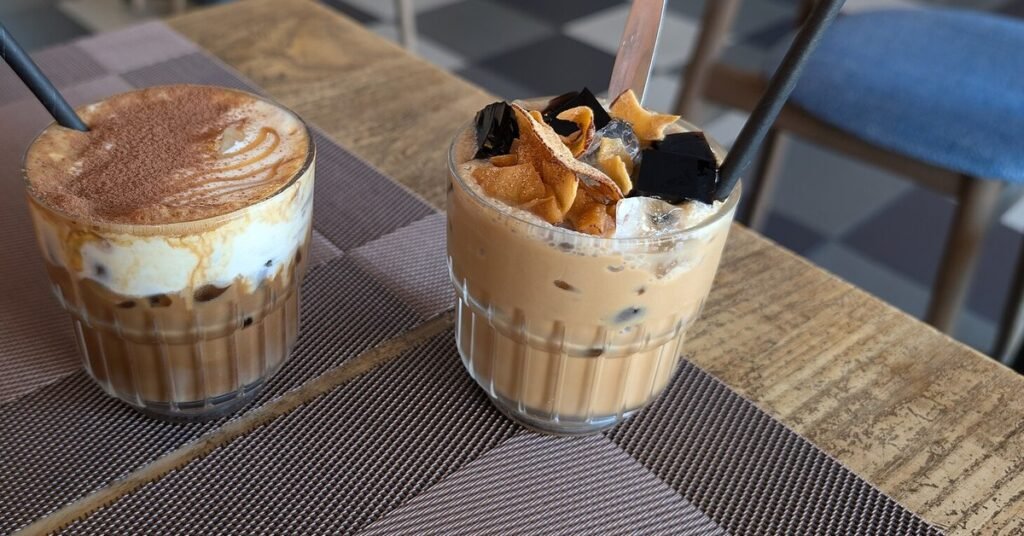
Vietnamese coconut coffee, or cà phê cốt dừa, is strong Vietnamese coffee, usually robusta brewed in a phin filter, sweetened with condensed milk and enriched with coconut cream or coconut milk. It is typically served cold, with the ice, coconut and condensed milk run through a blender, often until the mix is thick enough to eat with a spoon. Hanoi’s Cộng Cà Phê chain is the name most often linked to the drink, though accounts differ on who made it first.
What is Vietnamese coconut coffee?
Condensed milk, the sweetener in everyday Vietnamese iced coffee, does the same job here. The coconut can be coconut cream or canned coconut milk, and fresh milk often joins them: Vietnam’s national tourism site, VnExpress and VietNamNet all include it.
In Vietnamese, coconut milk is nước cốt dừa, hence cà phê cốt dừa. Recipe writers and the Michelin Guide also use the shorter cà phê dừa, and Cộng’s menu puts the coconut first: Cốt Dừa Cà Phê.
Styles vary. At Cộng, Saveur reports, a long spoon comes with each glass, handy for the dense, icy coconut layer and its crunchy toasted-coconut garnish. Cộng’s Vietnamese menu calls it a sinh tố, a smoothie. Some cafés blend the coffee in too, and Lonely Planet describes a shake-like version made by blending ice, coconut milk and coffee with a little condensed milk. Saveur, the Michelin Guide and VnExpress all describe a balancing act, sweet coconut and condensed milk set against a bitter coffee. Visitors meet it alongside egg coffee, salt coffee and yogurt coffee, VietnamPlus notes.
Origins: Cộng Cà Phê and a disputed history
Cộng Cà Phê takes its name from the opening of Cộng hòa Xã hội Chủ nghĩa Việt Nam, Vietnam’s formal title. According to the company, the chain began in October 2007, when Linh Dung gave her café at 152D Triệu Việt Vương, a street it calls Hanoi’s historic café street, a new look, handling everything herself from the menu to the furniture. The army-green rooms and old-style furniture are meant to recall thời bao cấp, the postwar subsidy era of her childhood. In October 2026 the chain’s store locator listed branches across Vietnam and in South Korea, Canada, Malaysia, Taiwan, the Philippines and France.
Coconut coffee is a Cộng signature. Cộng calls it the chain’s most loved drink and says the idea came from Kem Tràng Tiền, a Hanoi ice cream that, in the menu’s words, every Hanoian remembers. In October 2026 the online menu listed it at 59,000 dong for a small and 69,000 for a large.
The menu does not claim the drink as a Cộng invention, and other accounts disagree. A 2023 Hanoi Times article, republished by VietNamNet, credited Cộng with creating it, while Lonely Planet says it is unclear whether the recipe is traditional or Cộng’s, and a 2022 VietNamNet feature says its origin is still disputed. Writing in 2019 and 2022, Lonely Planet and VietNamNet each described it as having caught on with young Vietnamese only a few years earlier.
Coconut coffee also has a following in Hải Phòng. When Booking.com named five Vietnamese coffee destinations in 2024, the port city, about 120 km from Hanoi, was paired with coconut coffee, which VnExpress’s report on the list called a local favorite.
Where to try it
- Hanoi: Cộng’s store locator listed 26 Hanoi branches in October 2026, though not the original Triệu Việt Vương shop. Its menu also lists a stirred coffee with condensed milk and coconut milk, iced or hot, for anyone who wants the flavor without the slush.
- Ho Chi Minh City: Saveur’s 2026 guide to Saigon’s coffee drinks points to Cộng, and the Michelin Guide’s 2024 guide to Vietnamese coffee names Fashionista Café and Hoa Túc.
- Abroad: in the US, Vicky Pham notes, it turns up at Vietnamese coffee shops and boba shops, California especially, Việt Nam News reported Parisian interest in it at Vietnamese cafés in 2025, and Cộng’s own locator listed a Paris branch in October 2026.
Menus and branches change, so check before going.
Vietnamese coconut coffee recipe
Home recipes are blended, like the café slush, or stirred; the blended method comes first. The amounts are a starting point drawn from recipes by Vicky Pham, Hungry Huy, Sift & Simmer, Delightful Plate, Nguyen Coffee Supply and Analida’s Ethnic Spoon; they agree on method more than on quantities.
Ingredients (one glass)
- Coffee: 2 tablespoons (roughly 14 g) of medium-fine ground coffee, ideally robusta or a robusta blend, and about 1/2 cup (120 ml) of hot water. Per glass, published recipes range widely: Hungry Huy and Sift & Simmer each split one small brew between two glasses, which leaves under 2 ounces apiece, while Vicky Pham pours a full cup of bottled concentrate into each.
- Coconut cream: 3 tablespoons to start. Recipes using cream run from 2 tablespoons per glass (Hungry Huy) to 1/4 cup (Ethnic Spoon).
- Sweetened condensed milk: 1 1/2 tablespoons to start, within a range of 1 teaspoon (Sift & Simmer) to 2 tablespoons (Hungry Huy and Ethnic Spoon).
- Ice: about 1 cup for the slush, as in Vicky Pham’s and Hungry Huy’s recipes, plus more for the glass if you like.
- Optional: a splash of fresh milk and some toasted coconut.
That is roughly two parts coconut to one part condensed milk, near the middle of the published range. Adjust to taste. The recipe doubles easily, and two glasses also suit a full-size blender better than one.
Steps
- Brew and cool the coffee. Drip it through a phin into a heatproof glass or jug, without condensed milk; for bloom, grind and timing, see how to use a phin filter. Warm coffee would melt the slush quickly, so Hungry Huy gives it 15 to 30 minutes in the refrigerator first.
- Ready the coconut. For the smoothest slush, Vicky Pham suggests an optional step: warm the cream on the stove until any lumps melt, then let it cool completely. Either way, shake the can before opening it. Hungry Huy keeps the cream and condensed milk in the refrigerator beforehand, so the slush stays colder.
- Blend. Run the blender on high for about a minute, Vicky Pham’s timing, with the ice, condensed milk, coconut cream and any fresh milk inside, and stop once the slush is thick and no ice chunks remain. A strong blender helps. Taste it and adjust the way Hungry Huy does: more condensed milk for sweetness, more ice or cream for body, or a splash of coconut milk to loosen it.
- Froth the coffee (optional). The Michelin Guide and VietNamNet both describe shaking the coffee until a light foam forms, and Delightful Plate suggests a jar with a tight lid.
- Assemble. Pour the coffee into a tall glass and spoon the slush over it, or put the slush in first and pour the coffee on top, as Sift & Simmer does.
- Serve at once with a long spoon for stirring as you drink. A scatter of toasted coconut, as at Cộng, is optional.
The slush can be made ahead and kept in the freezer. Hungry Huy freezes it for 30 minutes to an hour for a thicker texture.
A note on strength: coconut and condensed milk soften the bitterness, but the caffeine comes from the coffee, so it depends mainly on the dose and the bean, and robusta carries more caffeine than arabica. For per-cup estimates, read why Vietnamese coffee is so strong.
Variations and substitutions
Coconut cream or coconut milk?
Coconut cream is a richer form of coconut milk: Cook’s Illustrated explains that it is made the same way with about four parts coconut to one of liquid. Hungry Huy finds coconut milk much more watery, and both Vicky Pham and Sift & Simmer point to cream for a richer or thicker result. Carton coconut milk is thinner still, Tasting Table notes. One product to leave out is cream of coconut, the sugary cocktail ingredient; Cook’s Illustrated warns that it cannot stand in for coconut cream.
Without a blender
Nguyen Coffee Supply stirs condensed milk, whisked canned coconut milk and a little regular milk together in a tall, clear glass, adds ice, and pours the coffee in last so it marbles through. Ethnic Spoon’s even simpler method works hot or, over ice, cold: stir a premix of coconut cream and condensed milk into strong coffee.
Hot coconut coffee
For a hot cup, Delightful Plate pours phin coffee, frothed first if you like, over coconut milk and condensed milk that have been warmed together to steaming point without boiling. Sift & Simmer suggests skipping the ice and adding more coconut milk, and Cộng’s English menu lists a hot coffee made with coconut milk and condensed milk.
Sweetness and dairy-free versions
Sweetened condensed milk is dairy: US federal rules define it as milk and sweetener with part of the water removed. Sweetened condensed coconut milk is the swap that Delightful Plate, Hungry Huy and Sift & Simmer all give for a dairy-free glass, and Delightful Plate adds that sugar works too. For less sweetness, use less condensed milk; Sift & Simmer omits it for a keto version.
Coconut coffee: how the Vietnamese drink differs from other versions
Other coffee drinks use coconut too, and some go by the name coconut coffee. The Vietnamese one is defined by strong coffee, condensed milk and, usually, a coconut slush. The others work differently:
- Coffee with coconut milk: coconut milk replaces dairy milk. When Starbucks made a Coconutmilk Latte permanent in the US and Canada in 2020, the recipe was steamed coconut milk with Blonde espresso, finished with cascara sugar.
- Coconut water coffee: espresso with coconut water and no cream. Dallmayr, the German roaster, pours a double espresso over ice and 150 ml of coconut water, sweetened with a teaspoon each of honey and brown sugar. Boon, a café in Sydney, used the plain name coconut coffee for a double shot poured into a freshly opened young coconut, owner Palisa Anderson told SBS in 2017.
- Butter and coconut oil coffee: Mayo Clinic describes “butter coffee” or “bulletproof coffee” as butter and coconut oil blended into coffee, though Cleveland Clinic notes that the original Bulletproof recipe calls for MCT oil. Mayo Clinic dietitian Katherine Zeratsky has warned about the saturated fat these add, and a 2018 Mayo Clinic report put a cup made with one to two tablespoons of butter and coconut oil at close to 500 calories, against 0 for plain coffee.
Frequently asked questions
What is cà phê cốt dừa?
It is the Vietnamese name for coconut coffee: phin-brewed coffee, typically robusta, sweetened with condensed milk and mixed with coconut cream or coconut milk, often blended with ice. Hanoi’s Cộng Cà Phê is the chain best known for it.
Can you make Vietnamese coconut coffee without a phin?
Yes. Hungry Huy gives a French press method, Nguyen Coffee Supply and Sift & Simmer allow espresso, and Delightful Plate suggests half a cup of very strong coffee. With a presweetened coffee concentrate, as in Vicky Pham’s recipe, use less condensed milk.
Is Vietnamese coconut coffee dairy-free?
Usually not. Sweetened condensed milk is made from milk, and many Vietnamese versions add fresh milk too. At home, sugar or sweetened condensed coconut milk can be used in its place.
Should you use coconut milk or coconut cream?
Hungry Huy and Vicky Pham both choose coconut cream for the blended drink, since it makes a heavier slush. Canned coconut milk gives a looser drink and is what Nguyen Coffee Supply’s stirred and Delightful Plate’s hot recipes use. Avoid cream of coconut, which is heavily sweetened.
Where can you get coconut coffee in Hanoi?
Cộng Cà Phê is the best-known option, with 26 Hanoi branches in its store locator in October 2026. Beyond Cộng, a 2023 Hanoi Times article republished by VietNamNet called the drink a fixture on Hanoi café menus.
Part of the Vietnamese coffee guide.
Featured image: Vietnamese salted coffee (left) and coconut coffee (right) at Xin Chao, a Vietnamese café in Eastbourne, England. Photo: Andy Li, CC0, via Wikimedia Commons (cropped).